Quartz dust extraction
What is silica dust?
Quartz is the most common form of crystalline silicon dioxide, generally referred to as crystalline silica. It is one of the most abundant minerals on earth and is present in virtually every stone-based building material.
An important distinction: quartz is crystalline silica. There is also amorphous silica, found in glass and diatomaceous earth, and it behaves entirely differently in the body. The regulations and health risks on this page concern the crystalline form.
Silica itself is not dangerous. A granite tile in the floor causes nobody any harm. The risk arises through mechanical work: cutting, grinding, drilling, milling, crushing and blasting turn solid material into a cloud of particles. And part of that cloud is small enough to reach the alveoli.
What contains silica?
The silica content varies widely between materials, and it determines how much you take in during the same operation.
- Engineered stone worktops: the highest content of all. The material consists largely of finely ground quartz set in resin.
- Sandstone and quartzite: very high content.
- Granite: substantial, depending on the type.
- Concrete, mortar and cement-bound products: the silica sits mainly in the sand and gravel. See also our page on cement dust.
- Foundry sand: in foundries during moulding, knock-out and sand reclamation.
- Silica-based blasting media: restricted or prohibited for open blasting in many jurisdictions, but still used in enclosed cabinets.
- Clay, ceramics and glass raw materials: when mixing and drying powders.
- Limestone and marble: notably low, which makes them less hazardous to work.
When in doubt, do not go by appearance but by the safety data sheet from your supplier. Two visually identical stones can differ significantly.
Why the finest fraction is what counts
With silica dust, how much dust you can see is not the measure. The visible dust - the grains that settle on your clothing - is largely stopped in the nose and throat and coughed back up.
The problem is the respirable fraction: particles below roughly four micrometres, which you cannot see and which stay airborne for hours. They are small enough to reach the alveoli. Once there, the body cannot clear them, because silica barely dissolves.
That explains two things often misjudged in practice. A workplace can look clean and still be well above the limit. And the colleague working twenty metres away, not cutting anything, breathes in the same fine fraction.
Health risks of silica dust
- Silicosis. The particles left behind in the alveoli trigger an inflammatory response that ends in scar tissue. The lungs stiffen and take up less oxygen. The process does not heal and continues even after exposure has stopped. At an advanced stage, any exertion becomes breathless.
- Lung cancer. Respirable crystalline silica is classified as carcinogenic to humans. There is no concentration below which nothing demonstrably happens, which is why the rule is to reduce exposure as far as technically possible rather than to sit just under the limit.
- COPD and increased susceptibility. Long-term exposure causes permanent breathlessness and raises the risk of pneumonia and tuberculosis.
- Accelerated silicosis from engineered stone. Cases have been emerging worldwide in recent years among young workers dry-processing engineered stone worktops. Because the silica content is so high, the disease develops not after thirty years but sometimes after five. It is currently the sharpest illustration of why dry working without extraction is not acceptable.
What makes silica dust insidious is the timescale. Someone breathing in too much today notices nothing for years. By the time the first symptoms appear, the damage is done and cannot be undone. That is precisely why extraction is the starting point rather than an afterthought.
Legislation and standards
The EU Chemical Agents Directive requires employers to assess exposure and reduce it as far as possible, following a fixed order of control: eliminate or substitute first, then engineering controls at source, then organisational measures, and only then respiratory protection. A mask is a supplement, never a substitute.
Respirable crystalline silica generated by a work process is listed under the Carcinogens and Mutagens Directive. That adds duties for substitution where technically feasible, records of exposed workers and health surveillance. A binding EU occupational exposure limit applies to the respirable fraction; member states may set stricter national values, so check what applies where you operate.
The exposure assessment follows EN 689, with measurements taken in the breathing zone. Air filters are classified under EN ISO 16890. The ATEX directives do not apply here: silica dust is not combustible and does not form an explosive mixture.
Sectors where silica dust plays a role
- Natural stone and engineered stone fabrication
- Construction, renovation and demolition
- Concrete and precast industry
- Foundries: moulding, knock-out and sand reclamation
- Extraction and processing of sand, gravel and aggregate
- Ceramics, glass and refractory industry
- Blasting operations and surface treatment
How do you extract silica dust effectively?
The principle is always the same: capture the dust where it is created. With silica this weighs more heavily than with almost any other dust, because the hazardous fraction is so fine that it spreads through the entire space once airborne. What you miss at source, general ventilation will not recover.
- At fixed machinery. Saw tables, grinding benches, crushers and sand reclamation get fixed source capture connected to a central installation. Because silica dust is hard and abrasive, the construction matters: wear-resistant or lined bends, generous radii and a wear-resistant fan impeller prevent leaking ducting within a few years. A pre-separator or cyclone takes out the coarse fraction and extends the service life of the main filter.
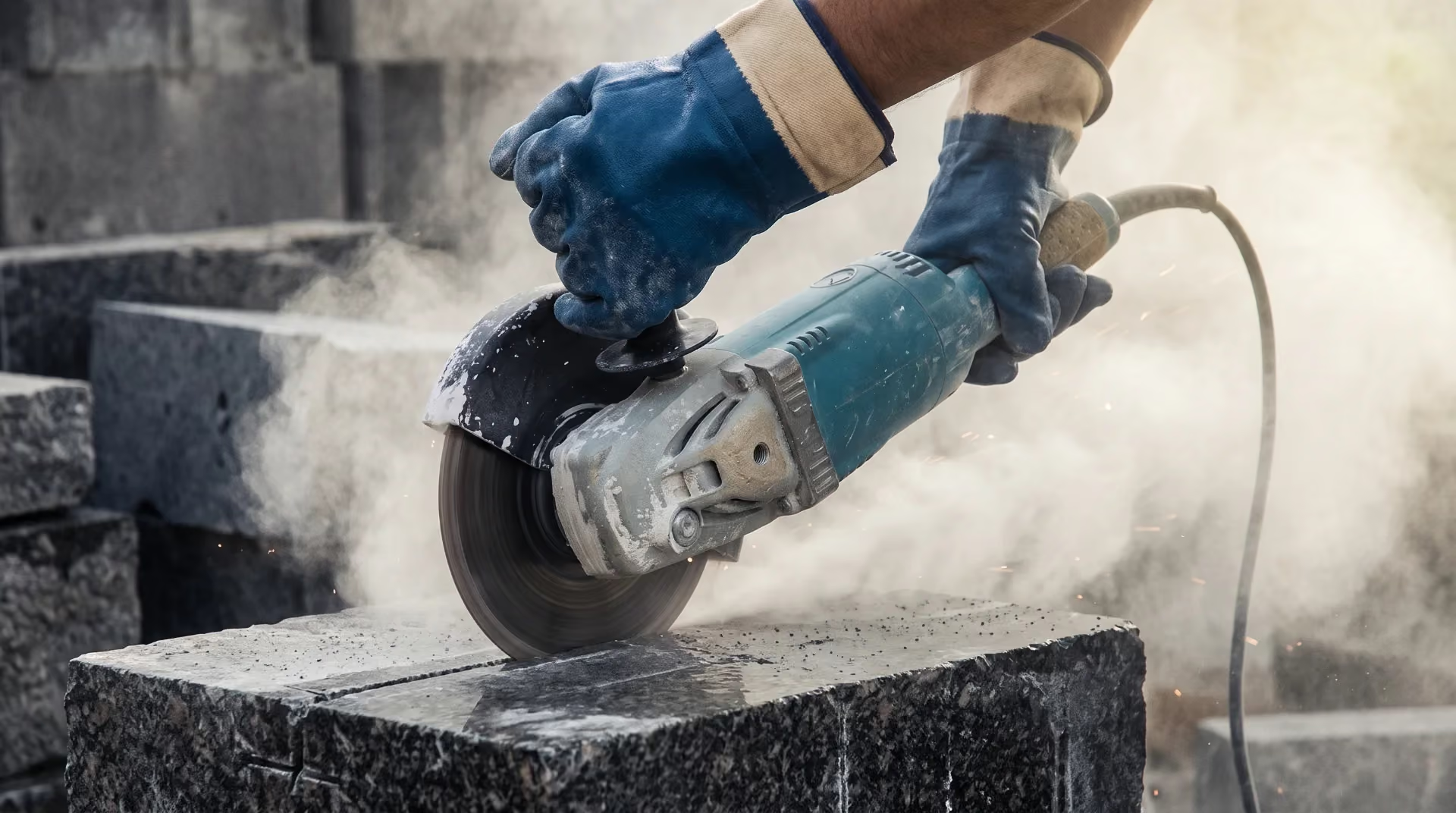
- At hand tools. Here the source is small and moves with the work. Tool-mounted extraction is the starting point: a vacuum connected directly to the grinder, saw or drill, with a shroud that captures the dust where the disc meets the material. Because of the carcinogen classification, dust class H is the benchmark. Check the airflow as well: an H-class machine moving too little air will still capture too little at the cut.
- Working wet. Water binds the dust at source and is the usual method in much stone fabrication. It is effective but not complete: once the slurry dries out the dust can become airborne after all, so cleaning up is part of it. And never connect a dry vacuum when working wet.
High-efficiency filtration is required for the finest fraction. Our engineers determine per situation which combination of capacity, filtration and construction suits the material, the process and the scale of your operation. If your work is mainly grinding and sanding across different materials, see our page on grinding and sanding dust as well.
Kiekens: your specialist in silica dust extraction
With more than 100 years of experience in industrial dust extraction we build installations for the hardest and most abrasive applications. From a single extracted saw table to central extraction for an entire stone workshop or foundry. We start by looking: which material, which process, where the operator stands. Then we design, install and maintain — from a single source. The Clean Air Plan keeps the installation performing year-round.
Want to know how much silica dust your workplace generates? Request a free baseline measurement from one of our specialists.
Estimating is not enough; measurement is required. An exposure assessment under EN 689 starts by identifying which tasks carry risk, followed by measurements in the worker's breathing zone — not somewhere in the workshop. There is no fixed interval: you measure at the start and again as soon as the material, tooling, working method or extraction changes. Because silica is carcinogenic, you must also keep records of who has been exposed.
A mask is the last step in the hierarchy, not the first. It protects only the person wearing it, only while it fits correctly, and not the colleague standing next to them. It also leaks the moment someone has a beard or lifts it to speak. That is why legislation requires capture at source first and personal protection only after that. In practice you use both: extraction as the baseline, respiratory protection as a supplement during peak exposure.
No. Dry sweeping stirs up precisely the fine fraction you were trying to avoid, and it then stays airborne for hours. The same applies to blowing down with compressed air. Use an H-class vacuum or clean wet. Settled silica dust is not a leftover from the job but a reserve that re-enters the breathing zone with every movement.
Yes, considerably. Engineered stone consists largely of finely ground quartz, whereas natural stone such as granite has a lower content. The same operation therefore exposes you to far more. That explains the cases of accelerated silicosis among young workers in the worktop trade. Dry-processing engineered stone without tool-mounted extraction or water feed is not defensible — not even for a single cut.