Mill Dust: Health Risks, Explosion Hazard and Extraction


What is mill dust?
Mill dust is the collective term for the airborne particles released in a grain mill during the processing of grain. It consists of two fractions: coarse grain dust from intake and cleaning, and fine flour dust that arises during milling and sifting as airborne flour.
Three components define mill dust, each differing markedly in particle size and hazard: grain dust (abrasion from kernels with plant and mineral impurities from the screenings, particularly critical from an explosion perspective due to its structure), flour dust (the finest airborne flour from milling and sifting, which as respirable fine dust penetrates deep into the alveoli of the lungs), and bran and husk particles (the outer layers of the kernel separated during milling, which become airborne as light suspended dust).
Because these fractions differ in particle size and behaviour, every machine in the mill produces a different type of mill dust, and only the process stage reveals where the exposure is greatest.
Where does mill dust arise in a grain mill?
Mill dust is generated along the entire milling process, from the grain silo to flour dispatch. The stages that release the most dust are those where the grain is transferred, cleaned and crushed between the rollers — above all conveying systems, milling equipment and silos.
Four process stages, each with its own emission profile, characterise the dust output of a grain mill: intake and cleaning (during tipping and in screening machines and aspirators, coarse grain dust along with screenings of dust, chaff and stones is released), milling at the roller mill (between the fluted and smooth rollers the kernel breaks down into flour, and the resulting heat drives fine flour dust out of the grinding gap), sifting at the plansifter (the stacked oscillating screens separate the milling fractions and in doing so disperse airborne flour), and mixing and bagging (at the filling spout and in the flour blending process, the falling material stream pushes the dust cloud out of the packaging).
The fine flour dust from milling differs markedly from the coarser dust from grain intake, and it is precisely its small particle size that makes it particularly hazardous to the respiratory tract.
What health risks does mill dust cause?
Mill dust places a burden on the respiratory tract and triggers allergic obstructive airway diseases. Grain flour dust is classified as a respiratory sensitiser, and flour dust is considered the most common cause of occupational asthma in the milling and baking industries.
In addition to its allergenic effects, mill dust contains endotoxins from bacteria, the concentration of which increases with the frequency of respiratory complaints. Millers and bakers are particularly affected, developing baker’s rhinitis and baker’s asthma as the most common occupational respiratory diseases. Because there is a clear dose–response relationship between the level of flour dust exposure and the incidence of disease, every reduction in dust concentration measurably lowers the risk.
Which exposure limits apply to mill dust?
For mill dust as a mixed dust, the general occupational exposure limit of 1.25 mg/m³ for the respirable fraction and 10 mg/m³ for the inhalable fraction applies across Europe. For sensitising grain flour dust, no toxicologically justified limit can be derived.
Instead, a minimisation principle applies, requiring dust concentration to be reduced as far as technically feasible. For occupational health surveillance, a level of 4 mg/m³ serves as the trigger threshold above which workers must be examined regularly. Since no safe lower limit exists for sensitising dusts, capture at the source remains the most effective protective measure.
Why is mill dust explosive?
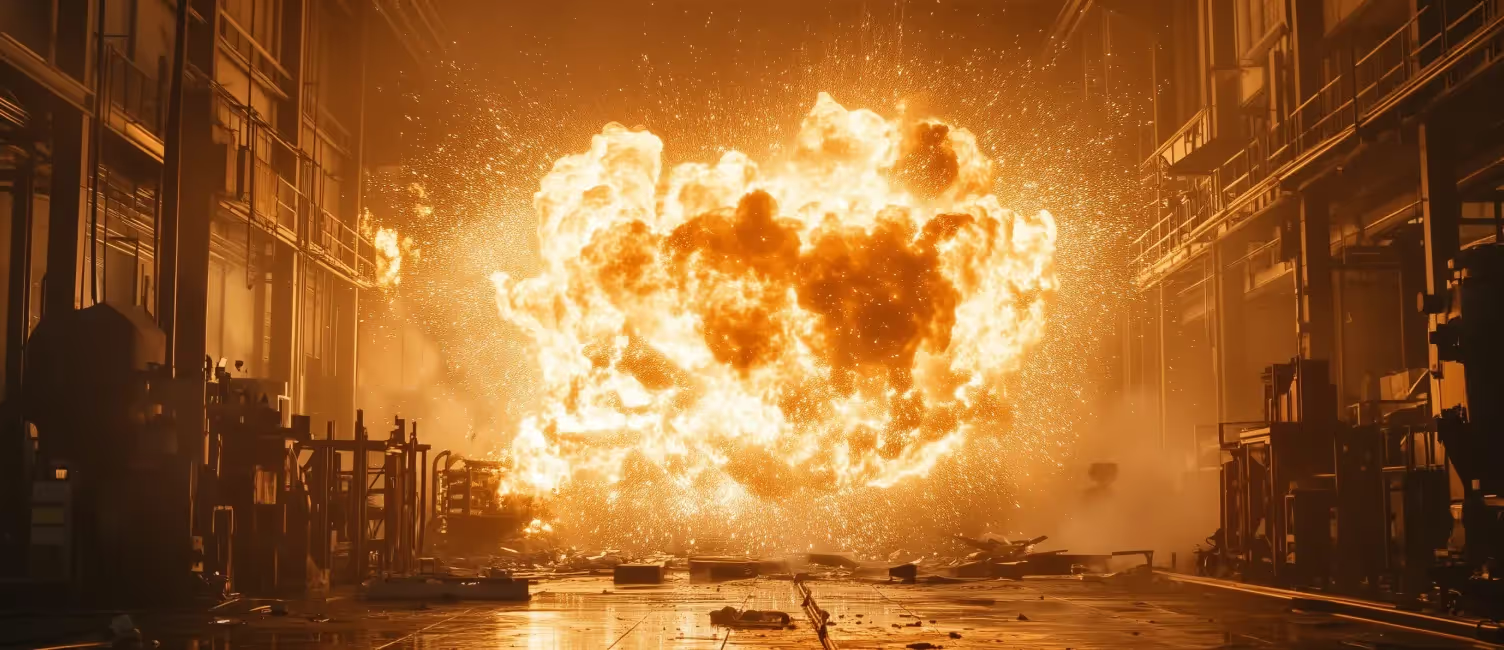
Mill dust is combustible and, when dispersed as a cloud, forms an explosive dust–air mixture. Particles below 0.5 mm ignite instantaneously, and the lower explosion limit for grain and flour dust is approximately 60 g/m³, triggered by a minimum ignition energy of around 10 mJ.
Grain and flour dust, with a KSt value of approximately 80 bar·m/s, belong to dust explosion class St 1 and reach a maximum explosion overpressure of 8 to 9 bar. Secondary explosions are particularly treacherous: a dust layer of less than one millimetre is sufficient, when disturbed, to fill an entire room with an ignitable mixture. How devastating the consequences can be was demonstrated by the Roland Mill in Bremen, where a flour dust explosion on 6 February 1979 killed fourteen people.
Which ATEX requirements apply in a grain mill?
In a grain mill, the ATEX Directives 2014/34/EU (for equipment) and 1999/92/EC (for workplace safety) apply. In the UK, the Dangerous Substances and Explosive Atmospheres Regulations (DSEAR) implement equivalent requirements. The operator classifies the dust-laden areas into ex-zones 20, 21 and 22 and documents the protective measures in an explosion protection document.
The zone determines which equipment category is permissible inside silos and filters, at roller mills or in the bagging area. Since these requirements demand ignition source elimination across the entire installation, the extraction system itself must also be designed in accordance with explosion protection rules.
How does extraction protect against mill dust?
Industrial extraction captures mill dust directly at the machine, before it settles in the mill or becomes airborne. Aspiration is therefore an integral part of the process in virtually every mill installation, accompanying the grain from intake to flour dispatch.
Extraction targets three critical machines in the mill to prevent dust escape and accumulation: the roller mill (a fan draws off the airborne flour from the grinding gap and de-dusts the machine, simultaneously preventing a dust explosion), the plansifter and semolina purifier (enclosed extraction keeps dust dispersed during sifting within the closed system), and bagging and dispatch (capture at the filling spout contains the falling material stream before it becomes a dust cloud).
For the extraction system to be approved in a potentially explosive area, the entire installation from capture through ducting to the filter must be conductive, earthed and free of ignition sources. Kiekens designs, manufactures and maintains such extraction solutions for the food industry as a turnkey system from a single source. As a specialist in industrial dust extraction with over 100 years of experience, Kiekens delivers everything in-house — from 3D engineering through the certified ATEX installation to the maintenance contract. This keeps the air in your mill clean and explosion protection demonstrably compliant at all times. Get in touch and arrange a free baseline measurement.
The ATEX guidelines distinguish six ex-zones: zone 0, 1 and 2 for gases, vapors and mists, and zones 20, 21 and 22 for flammable particulate matter. The classification is based on how often and for how long an explosive atmosphere can occur.
That's the operator. As part of the legally required risk assessment, you identify, classify, and document potentially explosive areas in the explosion protection document.
Only ATEX-certified equipment assigned to the correct category. The choice depends on the specific zone and the applicable requirements for ignition protection type and temperature class.
Yes. A professional dust extraction system can reduce dust concentration sufficiently to justify a lower zone classification. The system itself must fully comply with the ATEX requirements of the relevant zone. Kiekens supports you with documentation, zone classification and the required audits.