Dust extraction for sanding dust
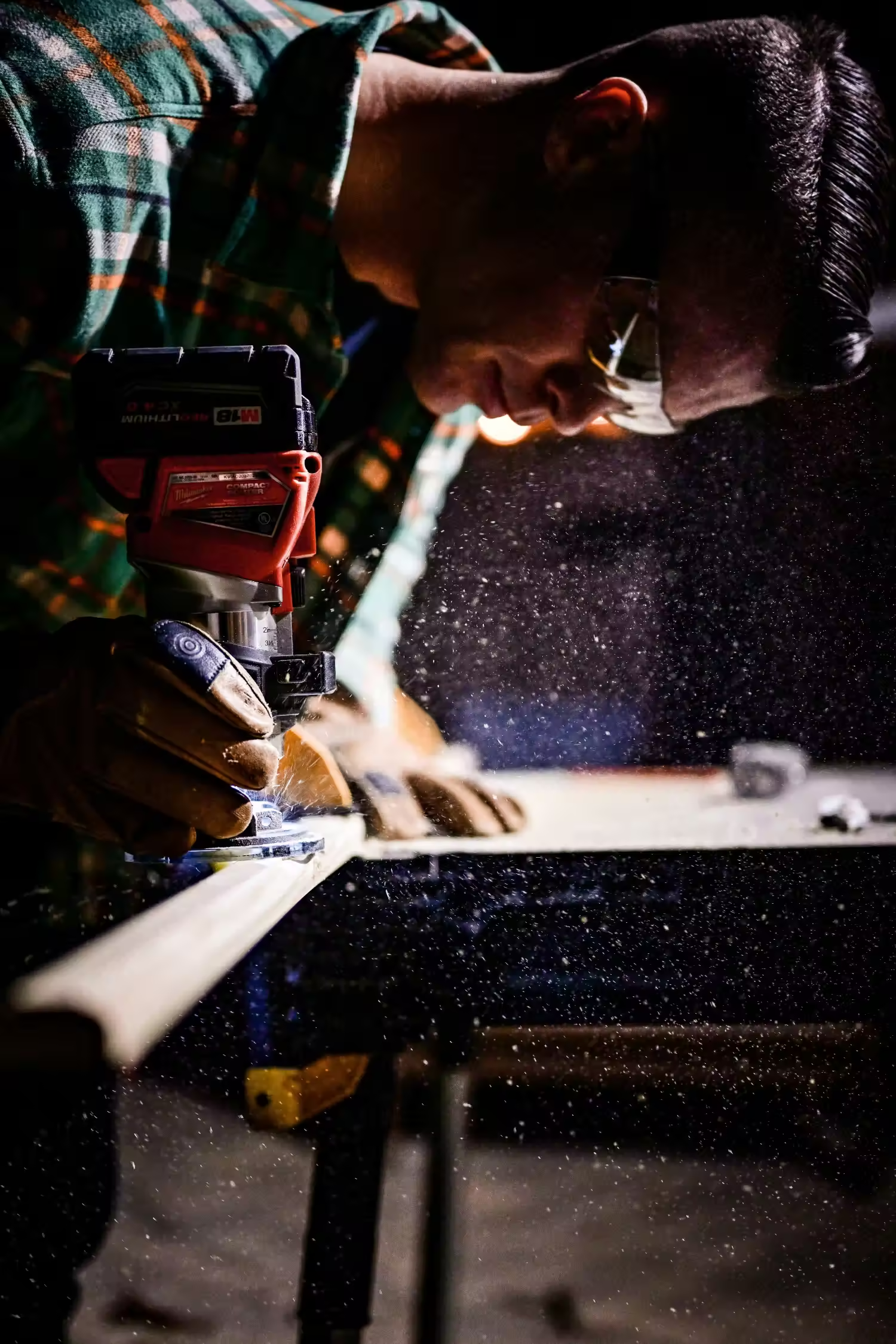
What is grinding and sanding dust?
This dust is released whenever surfaces are worked: sanding, grinding, polishing, deburring and blasting. By hand or by machine - the dust does not care.
Unlike grain or flour dust, the name tells you nothing about the contents. This is a process dust: the process is the same, but what is released is determined by the material being worked. What all the variants share is how fine they are. Abrasive machining produces a high proportion of fine particles, and it is that fraction that travels deepest into the lungs.
Why you cannot get it back out of the air
The smaller the particle, the further it travels. The coarser fraction is largely stopped in the nose and throat. The finer fraction carries on into the alveoli and triggers inflammation there.
Some of the smallest particles do not even stay in the lungs. They cross the lung tissue into the bloodstream, with consequences for the heart and circulation. This is why capture at source outweighs general ventilation in abrasive processes. Once dust is airborne in the workshop, you will not get it out before someone breathes it in.
What the dust brings with it, by material
Metal
Grinding metal releases fine dust that is often combustible as well. Stainless and alloyed grades contain chromium and nickel. An important detail: what matters is the compound form. Hexavalent chromium and certain nickel compounds are carcinogenic; the metals themselves are not. With aluminium and magnesium the explosion risk is the bigger problem, and the installation has to be ATEX compliant.
Wood
Sanding hardwood, softwood and panel materials such as MDF produces large quantities of dust. Hardwood dust is classified as carcinogenic, with cancer of the nose and paranasal sinuses as a documented outcome. Wood dust is also combustible and forms an explosive mixture at sufficient concentration.
Plastic
Here polymer particles are released, usually together with whatever is compounded into them: flame retardants, plasticisers, pigments. Those additives determine how harmful the dust is, not the polymer itself. The dust is also light and electrostatically charged, so it clings to everything and is hard to capture.
What the law asks of you
The EU Chemical Agents Directive requires you to assess and minimise exposure to hazardous substances, following a fixed order: eliminate first, then engineering controls at source, then organisational measures, and only then respiratory protection. A mask is a supplement, never a substitute.
For carcinogens such as hardwood dust and hexavalent chromium, the Carcinogens and Mutagens Directive adds further duties: substitution where technically feasible, and records of workers who have been exposed.
Where combustible dust is present - aluminium, magnesium, wood- the ATEX directives 2014/34/EU and 1999/92/EC apply, including zone classification and an explosion protection document.
Both directives are implemented in national law in each member state, so the specific limit values differ per country. Two standards are the reference point throughout: EN 689 for assessing inhalation exposure, and EN ISO 16890 for classifying air filters.
Sectors where this dust plays a role
- Metalworking and surface treatment
- Furniture and interior joinery
- Timber and panel product manufacturing
- Yacht building and composite fabrication
- Body repair and refinishing
- Plastics processing
How do you extract it effectively?
This dust is created at a small point that moves: where the tool meets the workpiece. That is exactly where you extract. It can be done through extraction built into the machine, through a downdraught bench that pulls the dust away beneath the work, or by enclosing the workstation entirely.
Which filter you need follows from the material. A pre-separator takes out the coarse fraction first, which makes the main filter last longer. High-efficiency filtration is needed for the finest fraction. With combustible dust, spark detection, pressure relief and earthed, conductive components are added - otherwise you are building your own ignition source.
Our engineers work out per situation which combination of extraction capacity, filtration and explosion protection suits your material, your process and your workshop.
Kiekens: your specialist in extraction for abrasive processes
With more than 100 years of experience in industrial dust extraction we know the difference between metal, wood and plastic dust from practice. We advise per situation: from a single downdraught bench to a central system serving an entire finishing department. The Clean Air Plan keeps the installation performing year-round.
Want to bring exposure in your workshop under lasting control? Contact one of our specialists for a no-obligation conversation.
Not as a rule. An ordinary workshop vacuum typically blows the finest fraction back into the room and, with combustible dust such as aluminium or wood, presents an ignition risk. Abrasive dust requires a vacuum of the appropriate dust class and, for combustible dust, an ATEX version with earthed, conductive components.
The dust class indicates how much dust a device may pass through. Class M is intended for dust with a limit value from 0.1 mg/m³, class H for carcinogenic dust and dust with a lower limit value. For hardwood dust and dust containing hexavalent chromium, class H is the starting point. Where several materials are worked, the most hazardous dust type determines the class.
Preferably not. Combining metal and wood dust in one system increases the risk: hot metal particles can cause wood dust in the filter to smoulder or ignite. Mixing also complicates disposal and recycling of the collected material. Where both processes take place in the same space, we advise separate extraction or separate collection with spark detection.
When metals, wood or plastics are sanded, microscopic dust particles are released that remain suspended in the air as particulate matter.
Fijnstof dringt diep door in de longen en kan leiden tot astma, COPD of zelfs kanker – vooral bij het verwerken van chroom of nikkel.
Depending on the type of dust and application: mobile units, stationary installations or point source extraction. Cyclones increase filter capacity.
Yes. Among others, NEN-EN ISO 15012-4, EU Directive 2004/37/EC (on the protection of workers from exposure to carcinogens or mutagens), the Hazardous Substances Regulation, and the ATEX directives set requirements for dust extraction and air quality.