Cement dust extraction
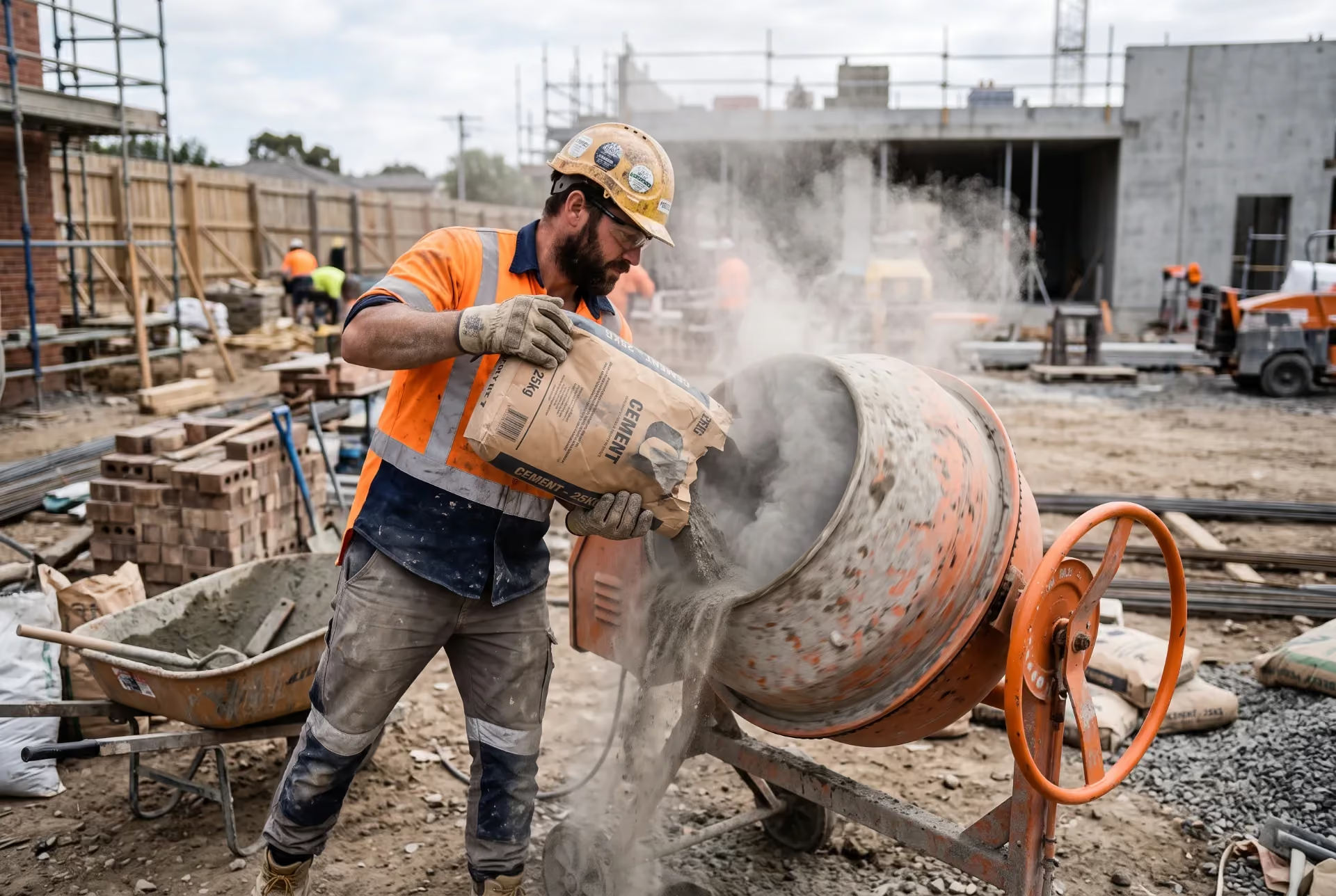
What is cement dust?
Cement dust is the fine powder released when cement and cement-bound materials are produced, moved and processed. Cement itself is a ground product of burnt limestone, clay and marl, with gypsum and additions such as blast furnace slag or fly ash.
It is a mineral dust: it does not burn and does not form an explosive mixture. What cement dust does do is react hydraulically. It sets as soon as it meets water - the very property that makes it useful as a building material.
Cement dust also contains a fraction of crystalline silica originating in the raw materials. In cement-bound materials such as concrete and mortar that proportion is considerably higher, because the aggregate consists largely of sand and gravel.
Where is cement dust released?
Exposure occurs in two very different settings, each calling for its own approach.
- In production and processing. Quarrying and crushing limestone, in the raw material and cement mills, at the clinker cooler, at silos and pneumatic conveying, and at the filling and loading points for bulk and bagged product. Ready-mix plants and precast concrete factories also generate dust during dosing, mixing and pouring.
- On the building site. Cutting, drilling, milling, grinding and breaking concrete, mixing mortar and screed, emptying cement bags and dry sweeping. The quantities are smaller here but the concentrations in the breathing zone are often higher, simply because the tool is used close to the face.
What makes cement dust difficult
Three properties determine what an installation has to look like.
- It sets. If condensation reaches the ducting or the filter medium takes up moisture, the dust hardens into a crust that a pulse of compressed air will no longer shift. That is the main reason cement installations get insulated or trace-heated ducting and dew point monitoring.
- It abrades. Cement dust is hard. At bends, transitions and fan blades it wears the material away, causing leaks and loss of capacity. Wear-resistant or ceramic-lined bends and generous radii extend service life considerably.
- It is fine. A large share of cement dust sits in the fraction that reaches the alveoli. Coarse separation alone is therefore never enough.
Health risks of cement dust
Cement dust carries three risks, each by a different route.
- The silica attacks the lungs. The finest particles reach the alveoli and stay there. They create scar tissue that does not heal, and crystalline silica is also carcinogenic. Because nothing is noticed for years, the damage is done before the first symptoms appear. What silica does exactly and which rules apply to it is set out on our page on silica dust.
- Wet cement burns. Dry dust on the skin is manageable, but as soon as sweat, rain or fresh mortar is involved it turns aggressive. That means cracked, itching hands - known on site as cement burn or cement eczema - and with prolonged contact, genuine chemical burns. In the eyes it stings immediately.
- The chromium causes allergy. Cement naturally contains a small amount of chromium, for decades the leading cause of skin allergy among bricklayers and concrete workers. Since cement has had to be supplied with a reduced chromium content this occurs far less often. But once someone has the allergy, they have it for life.
What extraction achieves here
The same applies to all three routes: personal protective equipment only works while it is worn and correctly fitted. Capture at source works continuously, for everyone in the space, including the colleague who is only passing through. That is also the order of control European legislation requires.
Beyond compliance, a properly functioning installation gives you something more: less absence and fewer long-term losses, demonstrable compliance during an inspection, cleaner products, and machines that last longer because abrasive dust is not reaching the bearings. A business is only truly healthy when its working environment is too.
Legislation and standards
The EU Chemical Agents Directive requires employers to assess exposure and reduce it as far as possible, following a fixed order of control: eliminate first, then engineering controls at source, then organisational measures, with respiratory protection last.
Respirable crystalline silica generated by a work process falls under the Carcinogens and Mutagens Directive, which adds duties for substitution where technically possible, records of exposed workers and health surveillance. A binding EU occupational exposure limit applies to the respirable fraction; member states may set stricter national values.
The exposure assessment follows EN 689. For cement placed on the market, the REACH restriction on soluble chromium(VI) applies. The ATEX directives do not apply to cement dust itself. If the same installation also handles combustible material - coal dust or biomass as kiln fuel, or fly ash with a high carbon content - they do apply to that part of the plant.
Sectors where cement dust plays a role
- Cement production and clinker grinding plants
- Ready-mix concrete plants
- Precast concrete and concrete products
- Sand-lime brick and building material manufacturers
- Construction, renovation and demolition
- Bulk cement handling and storage at ports and terminals
How do you extract cement dust effectively?
The approach differs sharply between plant and building site.
In production
Here you are dealing with large air volumes and continuous load. An installation typically combines source capture at tipping and transfer points, a pre-separator or cyclone for the coarse fraction, and a bag filter with jet-pulse cleaning for the fine dust. Silos get their own venting filter on the silo roof, so that displaced air during filling leaves through a filter rather than the pressure relief valve.
Three points deserve particular attention with cement:
- Moisture control: insulated or trace-heated ducting and dew point monitoring prevent the dust from setting inside the filter.
- Wear resistance: reinforced or ceramic-lined bends, generous radii and wear-resistant fan impellers.
- Returning the product: captured cement dust is still cement. Return it to the process where possible instead of disposing of it.
On the building site
Here the source is small and it moves. Tool-mounted extraction is the starting point: a vacuum of the appropriate dust class connected directly to the grinder, saw or drill. Because crystalline silica is classified as carcinogenic, dust class H is the benchmark here.
Cutting and drilling concrete also produces a lot of coarse material. A pre-separator between tool and vacuum keeps that out and stops the filter blinding within the hour. If you work wet, the water binds the dust - but do not connect a dry vacuum, because cement and water together in a filter create exactly the problem you were trying to avoid.
Our engineers determine per situation which capacity, filtration and construction suits your process, whether that is a cement mill or a precast hall.
Kiekens: your specialist in cement dust extraction
With more than 100 years of experience in industrial dust extraction we build installations for the heaviest, most abrasive applications. From a venting filter on a silo to a central extraction system serving an entire production line. We start by looking: where the moisture sits, where the ducting wears, where the operator stands. Then we design, build and maintain - from a single source. The Clean Air Plan keeps the installation performing year-round.
Want to know how much dust your production or your workplace generates? Request a free baseline measurement from one of our specialists.
There is moisture in the system. Cement sets with water, so as soon as condensation stands in the ducting or the filter medium takes up moisture, the dust hardens into a crust that pulse cleaning no longer shifts. Check the coldest points of the installation first: duct sections running outdoors, uninsulated stretches, and parts that cool down overnight while dust is still sitting in them. Insulation, trace heating and running the installation empty before a shutdown solve it in most cases.
Class H. What matters is not the cement itself but the quartz in it, which is classified as carcinogenic. Class M lets too much of the finest fraction through. Also check that the vacuum has enough capacity for the connection to your tool: an H-class machine moving too little air will still capture too little at the cut.
Water works well as dust suppression and is the standard solution on many machines, but it does not always replace extraction. It binds the dust as it is created, but once the slurry dries out it becomes airborne after all. On top of that, you must not connect a dry vacuum when working wet: cement and water together in a filter create exactly the setting problem you were trying to avoid. Work wet with a machine built for it, or work dry with capture at source.
Yes, and that is usually the intention. What ends up in the filter is simply cement, only finer. In a cement mill or ready-mix plant it can generally be returned to the process. Two conditions: the dust must have stayed dry, because set material is unusable, and it must come from a single product stream. With mixed dust streams or contamination from grinding residue this is not possible and it goes out as waste.