Powder coating dust: capturing it means recovering it
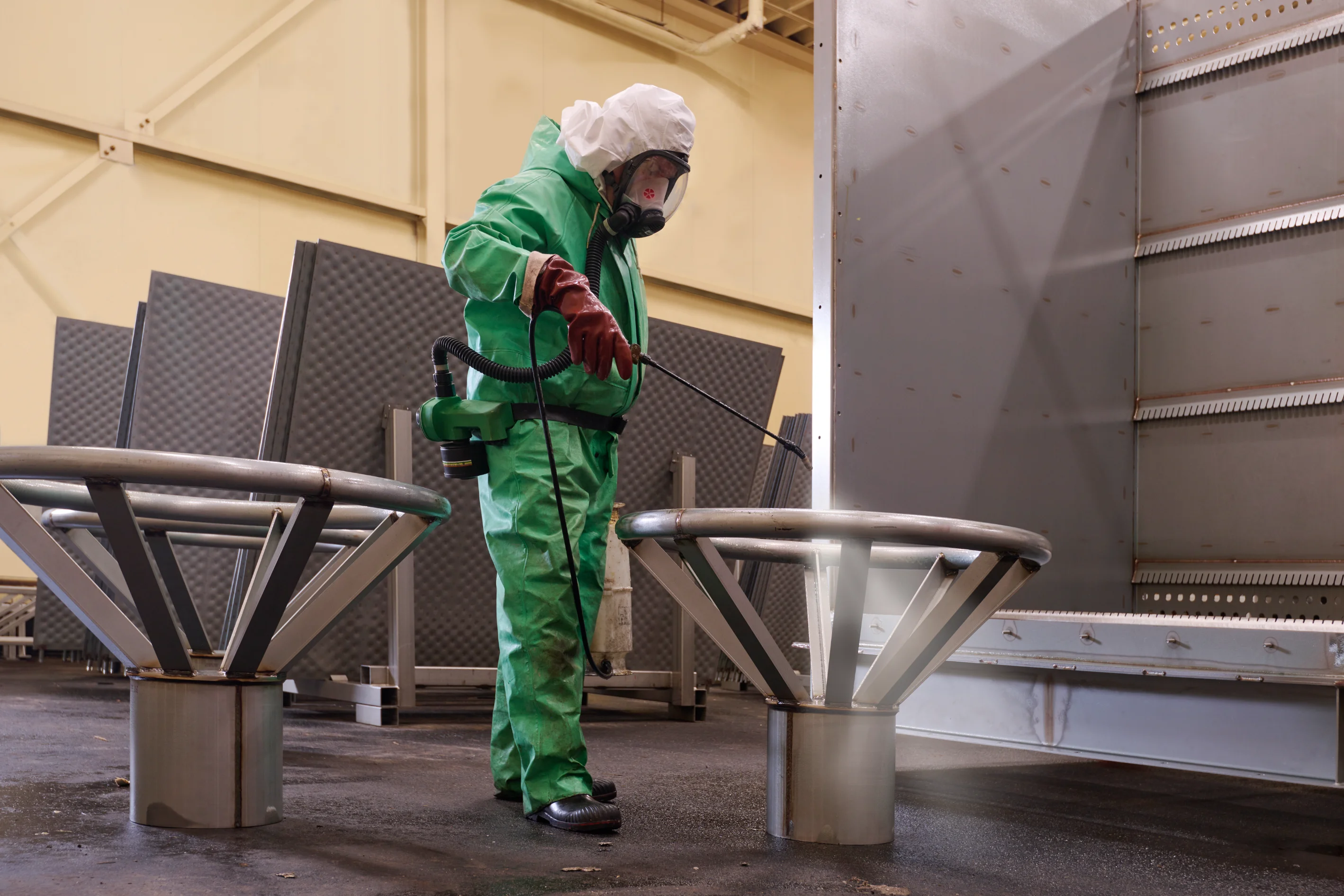
What is powder coating dust?
Powder coating dust is the overspray from the powder coating process: the portion of sprayed powder that does not land on the workpiece. Depending on the shape of the product, the spray settings and the operator's skill, a substantial share goes past.
The powder itself consists of thermosetting resin - usually epoxy, polyester or an epoxy-polyester hybrid - with pigments, fillers and curing agents. It is applied electrostatically: the powder is given a charge and the earthed workpiece attracts it. The product then passes into the curing oven, where the powder melts and cures into a closed film.
Those two steps each produce their own emission. In the booth it is solid dust. In the oven, curing releases a small quantity of gaseous reaction products from the curing system.
What sets powder coating dust apart
- It is still product. With almost any other dust, what you capture is waste. Here it is unused material you can put back to work. That changes the purpose of the installation: the cyclone in a powder booth is a recovery unit with a filter behind it, not a filter with a pre-separator in front.
- It is electrostatically charged. The powder is given that charge deliberately, to make it adhere, but it keeps the charge inside the extraction system too. As a result it clings to booth walls, ductwork and filter medium instead of flowing along. Everything has to be earthed and conductive - not only against ignition, but to keep the system working at all.
- It is combustible. Organic powder finely dispersed forms an explosive mixture. Most coating powders fall into dust explosion class St 1, but the exact values differ per formulation and are listed in your supplier's safety data sheet.
- A colour change is a cleaning operation. Switching to another colour means the whole line has to be powder-free, otherwise you get contamination in the coating. Booth, cyclone, ductwork and filter are all cleaned in one go. How easily that goes determines in practice how many colour changes you manage per day - and therefore your throughput time.
Health risks
The finest fraction of the powder reaches the alveoli. Prolonged exposure causes irritation of the eyes, skin and airways, and contributes to chronic respiratory complaints.
Composition matters as well. Epoxy resins and certain curing agents can act as sensitisers: the body can develop an allergy, resulting in contact dermatitis or occupational asthma. Once sensitised, a person reacts to very low concentrations. Which constituents your powder contains is set out in the safety data sheet - that is the starting point here, not the colour or the supplier.
Curing in the oven releases reaction products that need separate extraction. That is a gaseous emission, and a fabric filter does nothing against it.
For all of these routes, capture at source is more effective than personal protective equipment: it works for everyone in the space, including those not spraying themselves.
Legislation and standards
The EU Chemical Agents Directive requires employers to assess exposure and reduce it as far as possible, following a fixed order of control: eliminate first, then engineering controls at source, then organisational measures, with personal protection last. For powders without their own limit value, the general duty to minimise exposure applies. The exposure assessment follows EN 689, and limit values are set nationally, so check what applies where you operate.
Because coating powder is combustible, the ATEX directives 2014/34/EU for equipment and 1999/92/EC for workplace operation apply. The spray booth, the recovery cyclone, the ductwork and the filter all fall within scope. Measures are recorded in an explosion protection document.
Zone classification determines which equipment category is permitted. The interior of the booth and cyclone generally falls into a stricter zone than the surrounding space.
Sectors where powder coating dust plays a role
- Powder coaters and paint lines
- Metalworking with in-house finishing
- Façade and window frame manufacturing
- Machine and equipment building
- Bicycle, furniture and interior industries
- Appliance and cabinet manufacturers
How do you extract powder coating dust effectively?
The installation does two things at once: recover the powder and keep the air clean.
In the booth, the overspray is extracted directly so that it does not settle on the operator or on other products. The airflow is a balance: too little and the powder escapes, too much and you pull powder off the workpiece before it has cured.
The cyclone separates the usable powder from the air. It returns via a sieve to the supply hopper, usually blended with virgin powder in a fixed ratio. The better the cyclone efficiency, the less virgin material you need.
The after-filter captures the finest fraction the cyclone does not remove. That fraction is generally not reusable, because it is too fine for an even coating.
At the curing oven, separate extraction is needed for the gaseous reaction products. That is a different technique from dust filtration.
Across the whole line, everything must be conductive and earthed, with spark detection and pressure relief where the zone requires it. Electrostatic charge is both the operating principle and the risk here.
If your situation concerns not the application but the preparation - grinding or blasting before coating - see our page on grinding and sanding dust as well.
Our engineers determine the extraction capacity, cyclone design and explosion protection measures that suit your line.
Kiekens: your specialist in extraction for powder coating
With more than 100 years of experience in industrial dust extraction we design and build ATEX-compliant installations for paint lines and powder coating operations. From 3D design through certified installation to maintenance, from a single source. We start by looking: how much powder is currently lost, how long a colour change takes, where the operator stands. The Clean Air Plan keeps the installation performing year-round.
Want to know how much powder you could recover? Request a free baseline measurement from one of our specialists.
That depends on the cyclone efficiency, the shape of your products, and how often you change colors. The recovered powder is sieved and mixed with fresh powder in a fixed ratio, as the particle size of the recycled fraction differs slightly. Any fine particles that pass through to the after-filter are no longer usable.
Because the entire line must be powder-free before the next color is introduced: the booth, cyclone, piping, and filter. Residual powder from the previous color causes blemishes in the paint finish. The design of the installation directly determines your turnaround time here - smooth walls, good accessibility, and a quick-change cyclone save significant time.
This is due to the electrostatic charge the powder receives to help it adhere. This charge does not disappear into the extraction system. A fully grounded and conductive installation dissipates the charge, which both prevents sticking and stops the charge from discharging as a spark.
Yes, but differently than the booth. During the curing process, gaseous reaction products are released, which a fabric filter cannot capture. This requires a separate exhaust system, tailored to the type of powder and the oven load.
Only ATEX-certified equipment assigned to the correct category. The choice depends on the specific zone and the applicable requirements for ignition protection type and temperature class.
Yes. A professional dust extraction system can reduce dust concentration sufficiently to justify a lower zone classification. The system itself must fully comply with the ATEX requirements of the relevant zone. Kiekens supports you with documentation, zone classification and the required audits.