Dustmaster 20.000


The Dustmaster 20,000 in action
.webp)
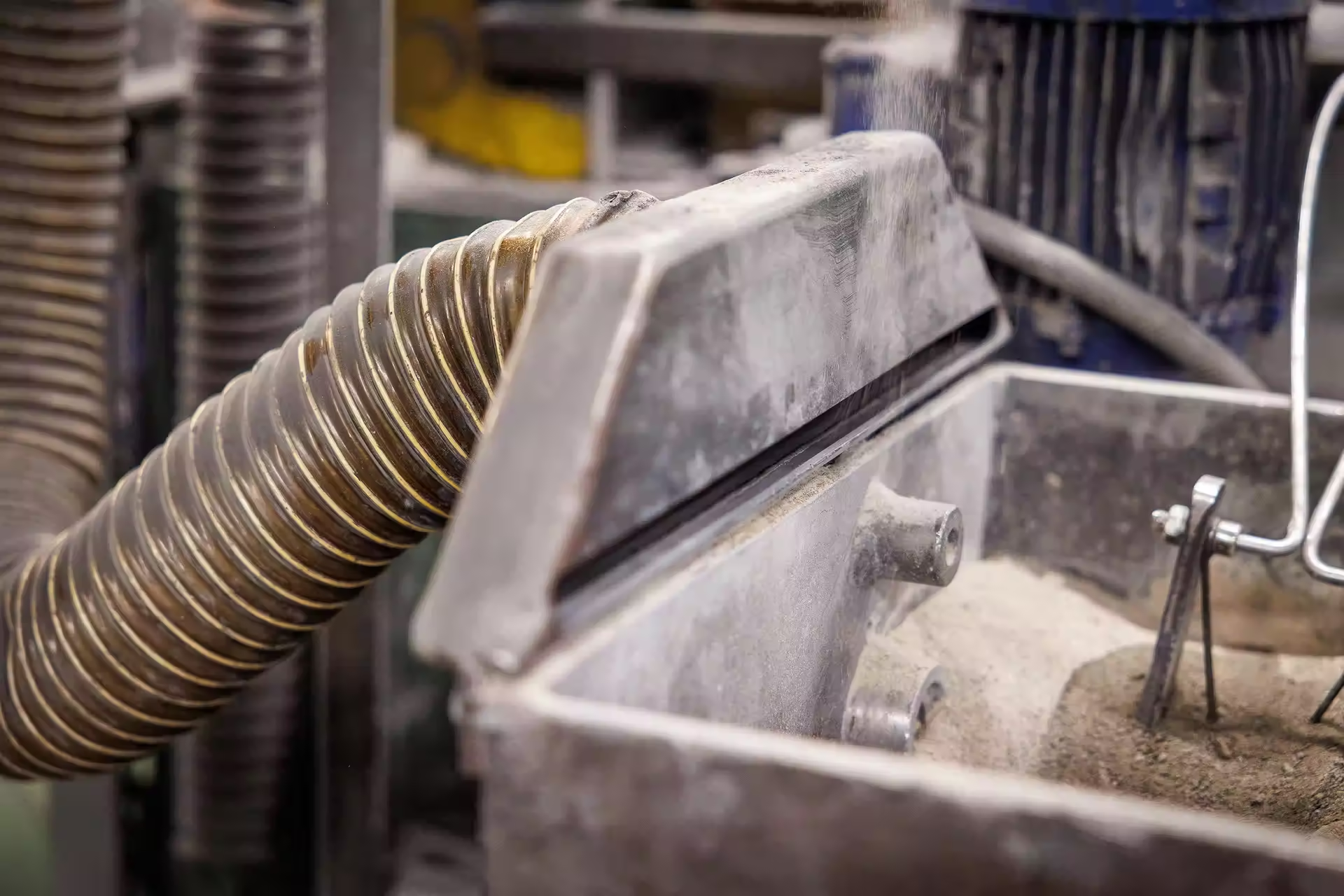

It can be built either vertically in case of limited available floor space, or horizontally in case of height restrictions. The capacity of the Kiekens Dustmaster DM20,000 series runs up to approx. 60000m³/h. There is also the possibility to link modules to handle larger air volumes. Kiekens offers many customer-specific versions and our engineers will be pleased to assist you in finding the right solution for you.
Your all-in-one partner for industrial dust extraction
Baseline measurement
Our specialists assess the current situation and identify dust levels, risks and opportunities.
Tailored advice
You'll receive a clear report with recommendations and a custom solution that complies with your industry’s standards.
3D engineering
Our engineers translate the advice into a tailored technical design – fully aligned with your needs, processes and environment. From 3D drawings and capacity calculations to smart, modular solutions that seamlessly integrate into your production process. This ensures a sustainable and future-proof installation.
Installation
We ensure professional on-site installation – including the construction of ductwork and full integration with your production environment. Everything is delivered fully operational and tested, so your workspace is immediately safer and cleaner.
Service & maintenance (SLA)
With a service agreement, you maintain full control over performance, uptime and safety. Our service team is always ready – day in, day out.


Shaped by our
unique approach
The Dustmaster 20,000 series is designed for industrial processes with large air volumes and high dust loads. Especially in continuous production processes and large-scale dedusting, the installation can be part of the overall solution.
During the baseline assessment, Kiekens determines which capacity, filtration, and dust discharge are needed.
The standard capacity runs up to approximately 60,000 m³/h. By combining modules, larger air volumes can be processed.
This makes it possible to match an installation to current production capacity while already taking future expansion into account during engineering.
Yes. The modular design allows for both vertical and horizontal configurations.
When little floor space is available, a vertical setup can be considered. With height restrictions, a horizontal configuration may be more suitable. The spatial constraints are taken into account during the baseline assessment and engineering.
With the downflow principle, contaminated air is directed toward the separated dust. Combined with a generously sized filter housing, this creates a calm airflow and relatively low air velocity.
This means the filters are subjected to less load, and even more difficult types of dust can be efficiently separated.
Depending on the selected filter material, residual dust levels of less than 0.5 mg/m³ and, in specific versions, even less than 0.1 mg/m³ are achievable. The choice of filter medium is matched to the dust properties, emission requirements, and process conditions.
The filters are cleaned with Jet-Pulse compressed air. An intelligent control system supports effective cleaning of the filter elements.
In addition, inspection doors and hatches provide access to the clean and dirty sides of the installation. Filter plates can be removed from the clean air side, making inspection and filter changes easier to manage.
Because filter plates can be removed from the clean air side, direct contact with separated dust during a filter change is limited.
For very harmful or process-critical substances, additional containment measures may be necessary. Kiekens takes these maintenance and exposure risks into account already in the design.
In addition to a dust bin, options include rotary valves, flap valves, and screw conveyors.
Which dust discharge fits best depends on the amount of dust and further processing. For large dust flows, automated discharge can help limit manual handling and production downtime.
Yes. Certified ATEX versions are available. Depending on the risk analysis, systems for explosion venting or explosion suppression can be applied.
Kiekens assesses not only the filter but the entire installation and its interaction with the production process.
The Dustmaster 20,000 can be equipped with various lamella filters, including PE, PE with PTFE coating, antistatic versions (PE-AS), ePTFE, and combinations thereof. This allows filtration to be tailored to the properties of the dust, the desired emission values, process temperature, and any ATEX requirements.
During the baseline assessment and engineering, Kiekens determines which filter material best fits your production process, looking not only at filter performance but also at factors such as cleanability, lifespan, and maintenance interval.
During the baseline assessment, we gather process data, dust properties, air volumes, spatial constraints, and safety requirements.
Our engineers translate this information into a customer-specific combination of filter modules, fans, protection systems, and dust discharge. This makes the Dustmaster 20,000 part of an extraction solution specifically designed for the production process.