Explosion Protection Document: Requirements, Content and Process

An explosion protection document is the legally required record of all the measures a company takes to prevent and control explosions. Across the EU, the ATEX Workplace Directive (1999/92/EC) obliges every employer to draw up this document as soon as an explosive atmosphere can occur; in the UK, the equivalent requirement follows from the Dangerous Substances and Explosive Atmospheres Regulations (DSEAR) 2002. Dust and gas explosions remain among the most underestimated risks in industry, even though the consequences can be severe. The explosion protection document maps these hazards systematically, defines protective measures and assigns hazardous areas to explosion zones. Without an up-to-date explosion protection document, a company has no evidence that it meets its statutory health and safety obligations.
What is an explosion protection document?
The explosion protection document records all identified explosion hazards within a company and describes the technical and organisational protective measures the employer has put in place. The document forms a specific part of the wider risk assessment and must be in place before work begins.
The explosion protection document serves three central functions. It demonstrates that the employer has systematically identified all potential explosion hazards. It describes the chosen protective measures at every level of protection. And it sets out the zone classification, which determines which equipment may be used in which areas.
The explosion protection document is not a one-off exercise. The employer must update the documentation after every safety-relevant change and review it regularly for completeness. This obligation to keep it current is what distinguishes the explosion protection document from a static record.
The zone classification within the document largely determines which equipment and installations may be used in a given area. The explosion protection document therefore also forms the basis for selecting a suitable dust extraction system and filter installation.
When is an explosion protection document mandatory?
An employer must draw up an explosion protection document as soon as hazardous explosive mixtures can occur in the company, or would occur without protective measures. This obligation applies regardless of company size or number of employees.
The document must be drawn up before work begins and before equipment is first used. If the risk assessment shows that no explosive atmosphere can form, the obligation lapses. Even so, it is advisable to record this absence of risk in writing, so that evidence is available in the event of an inspection by the relevant health and safety authority.
Explosive atmospheres occur in numerous industries. Six sectors are particularly affected:
- Metal processing: aluminium, magnesium and grinding dust with KST values of up to over 300 bar·m/s
- Wood processing: fine wood dust from sawing, milling and sanding from a concentration of 20-60 g/m³
- Plastics industry: dust from mechanical processing and fumes from extrusion or injection moulding
- Food industry: flour dust, sugar and starch particles in mills, silos and bakeries
- Chemicals and pharmaceuticals: solvent vapours, flammable gases and organic fine dusts
- Recycling: mixed combustible dusts and gases during mechanical processing
The documentation obligation applies equally across all these areas. The specific protective measures that the explosion protection document must contain depend on the outcome of the risk assessment.
What legal framework applies to the explosion protection document?
Across the EU, the ATEX Workplace Directive 1999/92/EC forms the central legal basis for the explosion protection document, transposed into national law by every member state. In the UK, DSEAR 2002 sets out the equivalent obligation. Six pieces of legislation and guidance are relevant to drawing up and implementing the document:
| Legal framework | Significance for the explosion protection document |
|---|---|
| ATEX Workplace Directive 1999/92/EC | EU-wide obligation for employers to assess and document explosion risks, transposed into national law in every member state |
| DSEAR 2002 (UK) | UK equivalent requirement for an explosion protection document, derived from the EU ATEX Workplace Directive |
| ATEX Equipment Directive 2014/34/EU | Sets the requirements for equipment and protective systems used in explosive atmospheres across the EU |
| UKEX equipment marking | UK equivalent certification scheme for equipment used in explosive atmospheres, mirroring the EU ATEX equipment categories |
| EN 60079-10-2 / BS EN 60079-10-2 | Harmonised standard for classifying zones with a dust explosion hazard, used across the EU and the UK |
| National implementing guidance | Member-state and UK guidance documents detailing the recommended structure and content of the explosion protection document |
The ATEX Workplace Directive requires employers to avoid hazardous quantities or concentrations of substances that could create an explosive atmosphere. National implementing guidance sets out a detailed structure for the documentation.
The EU Equipment Directive 2014/34/EU forms the technical foundation for equipment. It defines the equipment categories permitted in each zone and feeds directly into the content of the explosion protection document.
Alongside the pure documentation requirements, both EU and UK legislation also govern the recurring inspections of installations in explosive atmospheres. The inspection results form part of the explosion protection document. Before looking at the content in detail, it is worth clarifying a fundamental distinction: that between an explosion protection concept and an explosion protection document.
What is the difference between an explosion protection concept and an explosion protection document?
The explosion protection concept describes a company's safety strategy for preventing and controlling explosion hazards, while the explosion protection document provides the legally robust record of how that strategy has been implemented in full. The two terms are often confused, but they describe different things.
The explosion protection concept is drawn up in advance and comprises four steps:
- Identifying all areas where an explosive atmosphere can occur
- Assessing the explosion hazard in the areas identified
- Classifying the areas into explosion zones based on the frequency and duration of the hazard
- Defining and implementing technical and organisational protective measures
The explosion protection document records the results of this concept. The documentation includes the full risk assessment, the zone classification, all chosen protective measures and the organisational arrangements. The explosion protection concept is therefore a component of the broader explosion protection document.
In practice, this means: no concept, no document. The concept provides the substantive basis, while the documentation required under ATEX and DSEAR makes that basis demonstrable and verifiable.
What content must an explosion protection document contain?
The explosion protection document must contain the full risk assessment, the explosion protection concept and all organisational arrangements in a structured form. In practice, a complete document typically consists of seven main components.
1. Details of the company and work area
Identification of the company, business unit or work area, with a description of the structural and geographical conditions. The explosion protection document names the responsible person, the date it was drawn up, and refers to related documents such as working instructions or inspection reports.
2. Process description
A detailed description of the processes carried out, the substances used and the conditions under which explosive mixtures can form. The document also takes account of operating states such as start-up and shutdown, cleaning and maintenance, since concentrations often deviate from normal during these phases.
3. Substance data
A list of all combustible substances with their safety-relevant characteristics. Five parameters are particularly relevant for dusts:
- Flash point: the temperature at which a substance forms ignitable vapours
- Lower and upper explosive limit (LEL/UEL): the concentration range within which a mixture is explosive
- Ignition temperature: the minimum temperature of a hot surface that will ignite a mixture
- Minimum ignition energy (MIE): the amount of energy required to ignite a mixture
- KST value: a substance-specific measure of dust explosion severity, used to determine the dust explosion class St 1 to St 3
4. Assessment of the explosion hazard
The risk assessment within the explosion protection document answers three questions: can explosive mixtures form? Can these mixtures occur in hazardous quantities? Which areas are affected, and how often does the hazard arise? The answers determine the zone classification and the required protective measures.
5. Explosion protection measures at three levels
The explosion protection concept within the documentation is structured around three levels of protection:
- Primary explosion protection: preventing explosive mixtures through extraction of combustible dust and vapours at the source, inerting with nitrogen or CO₂, and limiting concentrations below the lower explosive limit
- Secondary explosion protection: preventing effective ignition sources through ATEX-certified equipment, earthing concepts against electrostatic charging, and temperature monitoring
- Tertiary explosion protection: limiting the consequences through pressure relief devices, explosion suppression systems and decoupling devices against flame propagation
6. Zone classification
Classification of all hazardous areas according to the frequency and duration of explosive atmospheres occurring. The zone classification determines the equipment categories permitted under the ATEX Equipment Directive 2014/34/EU.
7. Organisational measures
Details of working instructions, training and information for employees, maintenance and inspection schedules, permit-to-work procedures for hot work, and emergency plans. The organisational measures ensure that technical protective measures remain effective in day-to-day practice.
Fully documenting all seven components is a precondition for the legal robustness of the explosion protection document. The zone classification deserves particular attention, since it directly affects the selection of all equipment.
How does zone classification work within the explosion protection document?
Zone classification categorises hazardous areas according to the likelihood of an explosive atmosphere occurring, and determines which equipment and protective systems are permitted in each area. Six zones are distinguished, in two groups.
Zones for gases, vapours and mists
| Zone | Frequency of explosive atmosphere | Permitted equipment category |
|---|---|---|
| Zone 0 | Continuously, or for long periods | Category 1 |
| Zone 1 | Occasionally during normal operation | Category 2 |
| Zone 2 | Rarely, and only briefly | Category 3 |
Zones for combustible dust
| Zone | Frequency of explosive atmosphere | Permitted equipment category |
|---|---|---|
| Zone 20 | Continuously, or for long periods | Category 1 |
| Zone 21 | Occasionally during normal operation | Category 2 |
| Zone 22 | Rarely, and only briefly | Category 3 |
Zone classification has direct consequences for the entire fleet of equipment. In Zone 20, only equipment of the highest protection category, Category 1 under the ATEX Equipment Directive 2014/34/EU, may be used. Zone 22 permits Category 3 equipment with a basic level of protection.
For dust extraction systems in hazardous areas, zone classification means that all system components must be ATEX-certified, from the capture hood through the ductwork to the filter. The correct assignment must be recorded in the explosion protection document.
Who is allowed to draw up an explosion protection document?
Responsibility for drawing up and signing off the explosion protection document lies with company management, although drawing it up requires demonstrable expertise in explosion protection.
Three groups are typically suited to drawing up the document:
- Explosion protection specialists advise the employer on preventive explosion protection, support the risk assessment and prepare the documentation. They hold a specific qualification in fire and explosion protection.
- Health and safety professionals can take on the task, provided they have expertise in explosion protection and the underlying physical and chemical principles. Many companies are required by law to appoint or engage a competent health and safety professional.
- External experts or specialised engineering firms take over the work where in-house expertise is insufficient. This is particularly useful for complex installations with multiple zones and different dust groups.
Where no one within company management has the required expertise, the employer is obliged to seek competent advice. Responsibility nonetheless remains with company management in every case.
How often must the explosion protection document be updated?
The explosion protection document must be revised after every safety-relevant change in the company, since it is subject to the same review obligation as the wider risk assessment. There is no fixed review interval, but four situations typically trigger a revision:
- New or changed equipment, processes or substances used in the company
- Structural changes to installations or workplaces that affect the explosion protection concept
- New findings from incidents or near misses
- Reviews that show existing protective measures are not sufficiently effective
Neither EU nor UK legislation sets a single fixed minimum retention period for the explosion protection document, but in practice a retention period of at least ten years is common. Where substances with carcinogenic, mutagenic or reprotoxic properties are involved, occupational health legislation in most jurisdictions imposes additional, longer retention periods for the underlying exposure records.
In practice, an annual review of the document is advisable, even where no obvious changes have taken place. Gradual changes in production, such as increasing throughput or new materials, can alter the hazard situation without a single clear trigger being apparent.
What role does dust extraction play in explosion protection?
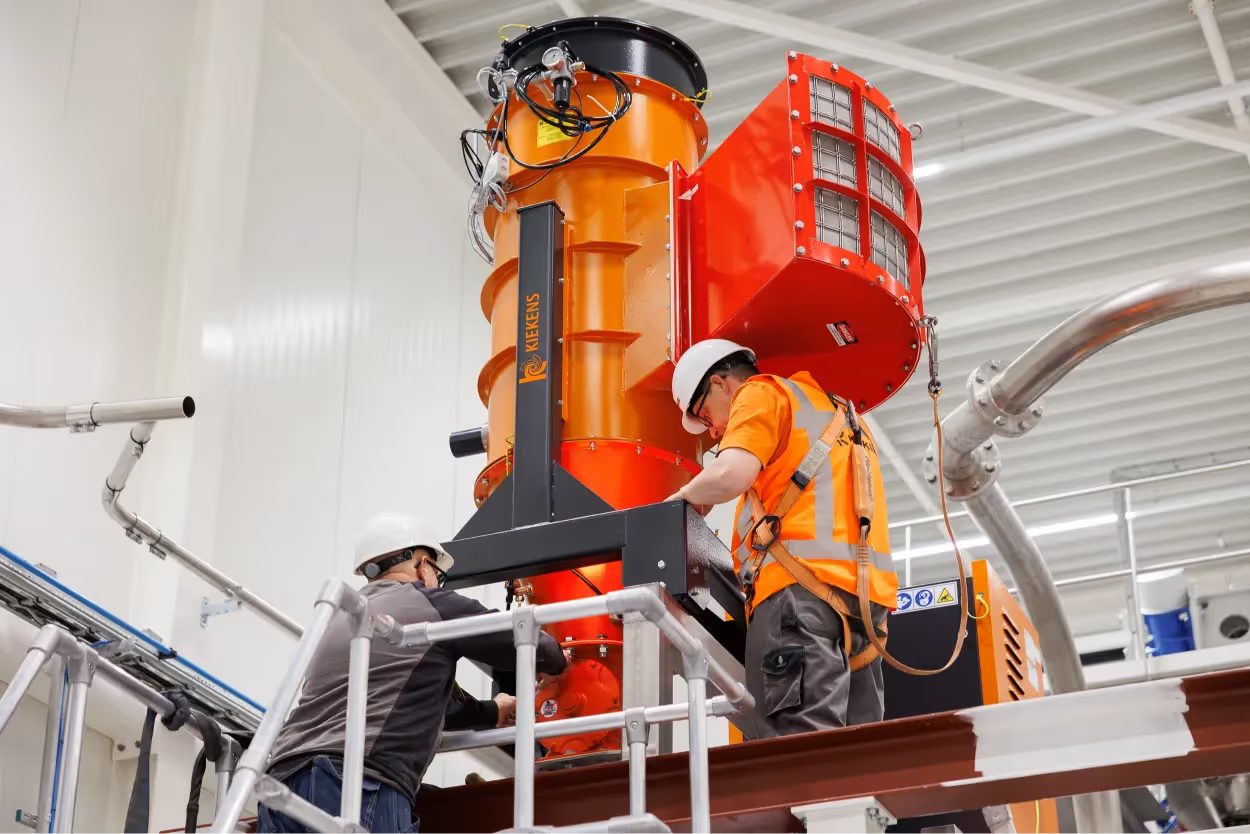
Dust extraction systems are the central technical measure within primary explosion protection, since they capture combustible dust, vapours and aerosols directly at the point where they arise and keep the concentration in the room air permanently below the lower explosive limit (LEL). The explosion protection document must record these systems with all relevant technical data.
Primary explosion protection through extraction
The most effective measure against explosions is preventing explosive mixtures from forming in the first place. Dust extraction systems reduce the concentration of hazardous substances at the source, before hazardous quantities can spread through the room air. With correctly sized airflow and capture hoods, the concentration of combustible substances remains permanently below the LEL.
Metal processing companies use dust extraction against aluminium and magnesium dust. Wood processing companies capture fine wood dust at saws, mills and sanders. Plastics processors filter dust and fumes during processing and extrusion. In every case, extraction is the first line of protection within the explosion protection concept.
ATEX-compliant dust extraction in hazardous areas
In areas where an explosive atmosphere cannot be fully ruled out despite extraction, all system components must be ATEX-certified. Four requirements shape the design:
- ATEX fans in a spark-free design, with an equipment category matching the zone classification
- Conductive ductwork with continuous earthing, to rule out electrostatic charging as an ignition source
- Explosion-protected filter installations with pressure relief, extinguishing systems or active explosion suppression
- Check valves and decoupling devices that prevent flame and pressure propagation through the duct system
Documenting the dust extraction system in the explosion protection document
The explosion protection document must fully record every dust extraction system that contributes to explosion protection. Five details are required:
- Airflow and capture efficiency at every extraction point
- Filter type, separation efficiency and dust class (L, M or H under EN 60335-2-69)
- ATEX category of all components, assigned to the relevant zone
- Maintenance intervals and inspection deadlines
- Earthing concept for the entire duct system
Fully documenting the dust extraction system simplifies regulatory inspections and ensures the technical protective measures are always demonstrable.
How to draw up an explosion protection document step by step
Drawing up an explosion protection document follows a systematic process in six steps, from identifying substances to ongoing review.
- Identify substances and processes: identify all combustible substances in the company, gather safety data sheets and document safety-relevant characteristics such as flash point, LEL/UEL, ignition temperature and KST value
- Assess the explosion hazard: analyse where and under what conditions explosive mixtures can form, taking account of operating states such as normal operation, start-up/shutdown and maintenance
- Define zones: classify the affected areas into zones (0/1/2 for gases, 20/21/22 for dust) according to the frequency and duration of the hazard
- Define protective measures: determine technical measures such as extraction, inerting and ATEX-compliant equipment selection, and add organisational arrangements such as training and permit-to-work procedures
- Compile the documentation: bring together all findings, measures and responsibilities in a structured explosion protection document
- Review regularly: update the explosion protection document whenever changes occur, check the effectiveness of the measures, and keep inspection reports as part of the documentation
ATEX-certified dust extraction from Kiekens
Kiekens has been developing dust extraction systems and filter installations for industrial applications for more than 100 years. For hazardous areas, Kiekens offers complete ATEX-certified solutions: from the capture point at the workplace, through conductive ductwork, to explosion-protected filter installations with pressure relief.
Kiekens dust extraction systems capture combustible dust and vapours directly at the source and reduce the concentration permanently below the lower explosive limit. All components are matched to one another and meet the requirements of the relevant explosion zone under the ATEX Equipment Directive 2014/34/EU.
Kiekens supports companies from design through installation to ongoing maintenance. The technical documentation for the system provides all the data required for the explosion protection document: airflow rates, separation efficiencies, ATEX categories and inspection intervals. Contact Kiekens for tailored advice.
Je ontvangt onder meer: de explosiebeschermingsdocumentatie, zoneindeling, certificaten conform ATEX 114 en ATEX 137, revisieplan en onderhoudsschema.
That's the operator. As part of the legally required risk assessment, you identify, classify, and document potentially explosive areas in the explosion protection document.
The ATEX guidelines distinguish six ex-zones: zone 0, 1 and 2 for gases, vapors and mists, and zones 20, 21 and 22 for flammable particulate matter. The classification is based on how often and for how long an explosive atmosphere can occur.
Only ATEX-certified equipment assigned to the correct category. The choice depends on the specific zone and the applicable requirements for ignition protection type and temperature class.