Dust explosion

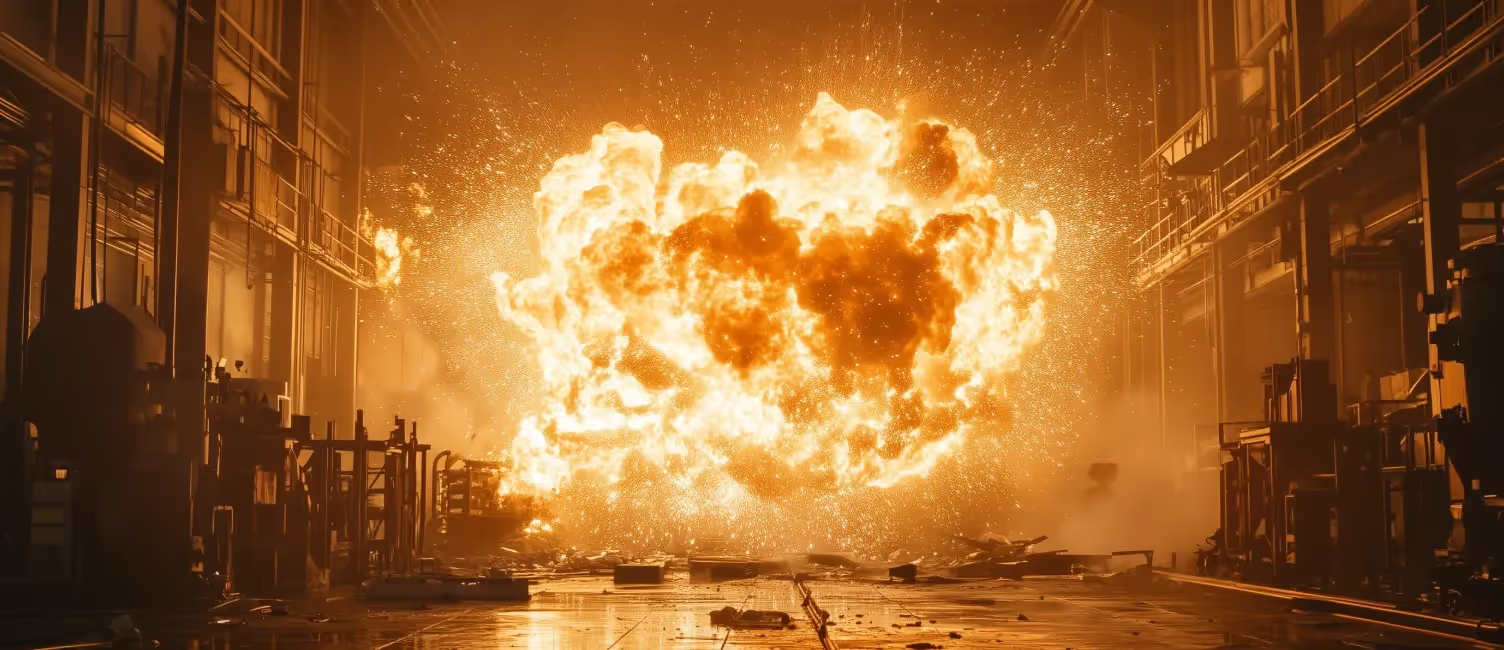
In a dust explosion, fine combustible dust hanging in the air as a cloud burns all at once. In a closed system, the pressure can rise to 10 bar.
Dust explosions happen more often than many companies think. Insurers in one large European industrial country reckon with an average of one dust explosion a day. How does such an explosion start, how does it develop, and which ATEX rules and measures protect your plant?
What is a dust explosion?
Fine solid particles in the air burn so fast that the hot gases expand suddenly. That pressure surge does most of the damage. It tears open vessels, ducts and even buildings.
In physical terms it is a deflagration: the flame front travels slower than sound. How severe the explosion is depends mainly on the space around it. In a closed filter housing or silo the full pressure builds up. In an open space, a small dust cloud often ends as a flash fire.
Your risk assessment shows which materials form combustible dust with an explosion risk. Combustible dust on its own never explodes. Several conditions have to be met at the same time.
How does a dust explosion start?
Combustible dust is finely dispersed in the air, at a concentration above the lower explosion limit. Add an ignition source in an enclosed space, and the pressure rises within milliseconds.
The explosion pentagon sums up the conditions. All five must be present at once:
- Combustible dust: organic materials such as wood, flour and sugar, or metal dust from aluminium and magnesium.
- Oxygen: usually simply from the air.
- Fine dispersion: dust stirred up into the air, forming an ignitable mixture.
- Ignition source: sparks, hot surfaces, flames or static discharge.
- Confinement: a vessel, filter, silo or room in which pressure can build up.
Remove one, and there is no explosion.
When can combustible dust cause a dust explosion?
As soon as the dust contains particles smaller than 0.5 millimetres and the concentration exceeds the lower explosion limit. Below roughly 20 grams per cubic metre, a dust-air mixture is usually not considered ignitable.
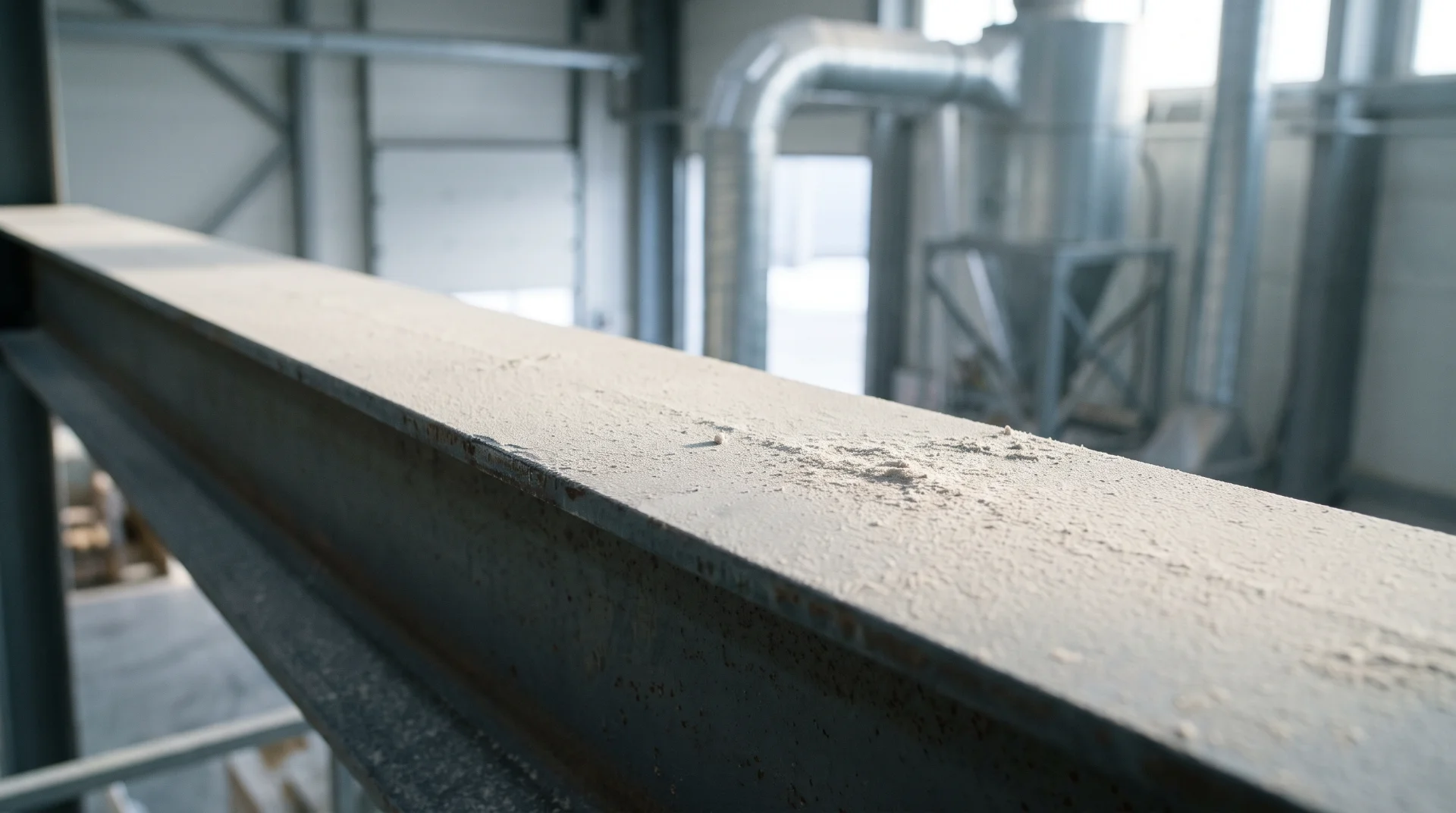
A rule of thumb: once more than 5 percent by weight of a dust is finer than 500 micrometres, an explosion risk cannot be ruled out. The finer the dust, the larger the reactive surface and the more violent the combustion. A dust layer of more than one millimetre over a large area is already dangerous. Stirred up, it can fill an entire hall with an explosive cloud.
Why is flour dust so dangerous?
Flour consists of starch and protein: combustible, organic material. As a fine powder it also has a very large surface. Dispersed in the air, flour ignites all at once. In a heap it only chars slowly.
The worst flour dust explosion in Germany happened on 6 February 1979 at the Rolandmühle mill in Bremen. A cable fire set off a chain of smaller explosions. 14 people died and 17 were injured, some of them seriously. For mills and bakeries, fine dust from wheat and rye flour is a double risk: for the lungs and for safety.
How does a dust explosion develop?
Usually in two stages. A first, often small explosion sends a pressure wave through the space that stirs up dust layers. That new cloud ignites and causes a much heavier second explosion.
In a production plant this happens as a chain reaction in five steps:
- Ignition: dust catches fire in a mill, bucket elevator or filter.
- Primary explosion: pressure rises within milliseconds and tears open housings, flaps or ducts.
- Dust lift: the pressure wave runs ahead of the flame and blows dust off beams, pipes and machines.
- Secondary explosion: the flame ignites the new, often much larger dust cloud.
- Fire: smouldering residues and burning deposits cause follow-on fires in silos and buildings.
What is a secondary dust explosion?
The follow-on explosion of dust stirred up by the first explosion. It usually does the most damage, because far more dust lies in halls, on beams and in ducts than inside the plant itself.
At the Imperial Sugar refinery in Port Wentworth (USA), the explosion started on 7 February 2008 in an enclosed conveyor belt under the silos. It then ignited accumulated sugar dust in the adjoining buildings. 14 workers died and 36 were injured.
The ignition source decides whether a dust explosion starts. How clean the hall is decides how big the damage gets.
Which ignition sources cause a dust explosion?
In industry mainly hot surfaces, mechanical sparks, smouldering nests, static discharge and electrical equipment. The standard EN 1127-1 distinguishes 13 types in total, from flames and lightning to self-ignition.
In plants handling dust, daily production usually involves these six:
- Hot surfaces: overheated bearings, motors, dryers and lamps.
- Mechanical sparks: screws or stones in a mill, or sparks from grinding and milling.
- Smouldering nests: smouldering dust carried by the product flow into conveyors and filters.
- Static discharge: charge build-up on conveyor belts, plastic pipes and filter bags.
- Electrical equipment: sparks at switches, connectors and damaged cables.
- Open flames: welding, cutting and soldering in dusty areas.
Whether a spark or hot surface actually ignites anything depends on the minimum ignition energy and the minimum ignition temperature of the dust. Fine aluminium dust ignites below 1 millijoule, sugar and milk powder at 10 to 100 millijoules and wheat flour only above 100 millijoules.
Hot surfaces may reach no more than two thirds of the minimum ignition temperature of the dust cloud (MIT). With dust layers up to 5 millimetres, they stay at least 75 kelvin below the layer ignition temperature (LIT). What that means in degrees differs per dust. An example: a dust with an MIT of 200 °C and an LIT of 250 °C. Two thirds of 200 °C is 133 °C, and 250 °C minus 75 kelvin is 175 °C. The lower of the two, 133 °C, sets the maximum surface temperature of the equipment.
Ignition sources can never be fully ruled out in production. That is why it matters most where explosive dust collects in your plant.
Where do dust explosions happen in industry?
Mainly in silos, dust extraction systems and filters, mills, and conveying and drying systems. That is where dust is constantly stirred up or collected, and where dust cloud, confinement and ignition source come together.
An analysis of almost 600 cases shows that reported cases represent only around ten percent of all dust explosions, and that extraction systems are involved more and more often. Five sectors carry the highest risk:
- Woodworking: sanding and milling dust from edge and wide-belt sanders.
- Food and animal feed: flour, sugar, starch and grain dust from milling, conveying and filling.
- Metalworking: grinding dust from steel, magnesium and fine aluminium from polishing.
- Plastics and chemicals: plastics, powders and pigments in mixers and dryers.
- 3D printing: metal and plastic powders.
How strong is a dust explosion?
You express it in the maximum explosion pressure and the KSt value: the maximum rate of pressure rise, scaled to the vessel volume. Organic dust usually reaches 7 to 10 bar in a closed vessel. Some metal dusts go higher.
Based on the KSt value, every dust falls into one of three dust explosion classes. They determine how you design the protection:
| Dust explosion class | KSt value | Typical materials |
|---|---|---|
| St 1 | up to 200 bar·m/s | wood dust, flour, sugar, grain, animal feed |
| St 2 | 200 to 300 bar·m/s | cellulose, wood flour, some plastic powders |
| St 3 | above 300 bar·m/s | fine aluminium and magnesium powders |
The KSt value is measured to EN 14034 in a 20-litre sphere or a 1 cubic metre vessel. It is the basis for determining the dust explosion class and protection. Even an St 1 dust can tear steel walls apart in a filter housing. Explosion protection therefore starts with prevention. Venting comes later.
How do you prevent a dust explosion?
You avoid dust and explosive dust-air mixtures as far as possible, rule out ignition sources and limit the effects of an explosion by design. ATEX Directive 1999/92/EC sets this order of priority:
- Prevent an explosive atmosphere: extraction at the source, enclosed transfer points, regular cleaning and inerting, where nitrogen displaces the oxygen.
- Prevent ignition: ATEX-compliant equipment, earthing against static charge, magnetic separators against foreign objects and spark detection in ducts.
- Limit the effects: design measures for when things go wrong anyway.
Remove settled dust with explosion-proof industrial vacuum cleaners. A broom or compressed air only stirs the dust up again. A cleaning plan sets how often beams, cable trays and machines are cleaned, so that no dangerous layers build up.
Which design measures limit a dust explosion?
Measures that withstand, release, suppress or isolate pressure and flame, so that people and nearby plant sections stay safe. The European standards describe four methods that can be combined:
- Explosion-resistant design: vessels and filter housings withstand the maximum explosion pressure.
- Explosion venting: bursting discs or vent panels open and release pressure and flame to a safe area.
- Explosion suppression: sensors detect the pressure rise and an extinguishing agent smothers the explosion within milliseconds.
- Isolation: non-return flaps and rotary valves stop the explosion from spreading through ducts to other parts of the plant.
Which ATEX rules apply to dust explosions?
Two EU directives apply: ATEX 1999/92/EC for employers and ATEX 2014/34/EU for manufacturers of equipment and protective systems. Each EU country has written them into its own law. In the UK, the Dangerous Substances and Explosive Atmospheres Regulations 2002 (DSEAR) cover employers, and separate UK product regulations cover equipment.
Since 30 June 2006, existing workplaces with an explosion risk must also meet the minimum requirements of Directive 1999/92/EC. If you run plant that handles dust, you have four duties:
- Risk assessment: determine whether and where an explosive atmosphere can form, including the properties of the dust.
- Zoning: classify work areas into dust zones 20, 21 and 22, based on how often and how long an explosive atmosphere is present.
- Equipment selection: category 1D, 2D or 3D equipment to suit the zone.
- Documentation: record all measures in writing before work starts, and update them after significant changes.
The explosion protection document is required under Article 8 of Directive 1999/92/EC. The less dust a plant releases, the smaller the ATEX zones.
What role does the extraction system play?
An industrial extraction system captures dust where it is created. That keeps the concentration in the hall below the lower explosion limit and stops dust layers forming on beams and machines. At the same time, extraction keeps the air clean and the workplace healthy.
The extraction system is itself a risk point. Fine dust collects in the filter all the time, and the inside is often classed as zone 20. An ATEX-certified extraction system combines dust capture with venting on the filter, isolation of the ducts and earthed, conductive components.
How well a central extraction system for production halls keeps the air clean and the hall safe depends on how precisely capture points, ductwork and filter are matched to your dust.
Kiekens is your partner for industrial dust extraction
Since 1907 we have built custom dust extraction for companies handling combustible dust, from wood and metalworking to food and animal feed. We do the engineering, manufacturing in the Netherlands, installation and service and maintenance ourselves. From 3D design to certified ATEX installation.
Book a free on-site baseline measurement. We measure the dust load and assess your machines, filters and dust sources.
Sinds de norm EN 60079‑10‑2 zijn stofzones gedefinieerd als Zone 20 (duurzaam aanwezig), Zone 21 (regelmatig) of Zone 22 (soms). Dit bepaalt de apparatuurcategorie en beschermingsmaatregelen.
Dust explosion class St 1 indicates that a substance has a moderate explosiveness, with a KST value of up to 200 bar·m/s. This means that protection measures in accordance with ATEX guidelines are required, but these are less complex than, for example, St 3.
Finely distributed industrial dust from metals such as aluminum or magnesium, organic substances such as flour, sugar or wood, as well as coal dust, plastic dust and color pigments are potentially explosive and therefore a danger. A dust explosion can occur as soon as the dust in the air reaches a certain concentration and an ignition source is present. Preventing a dust explosion starts with the use of powerful extraction systems.