Sugar dust extraction
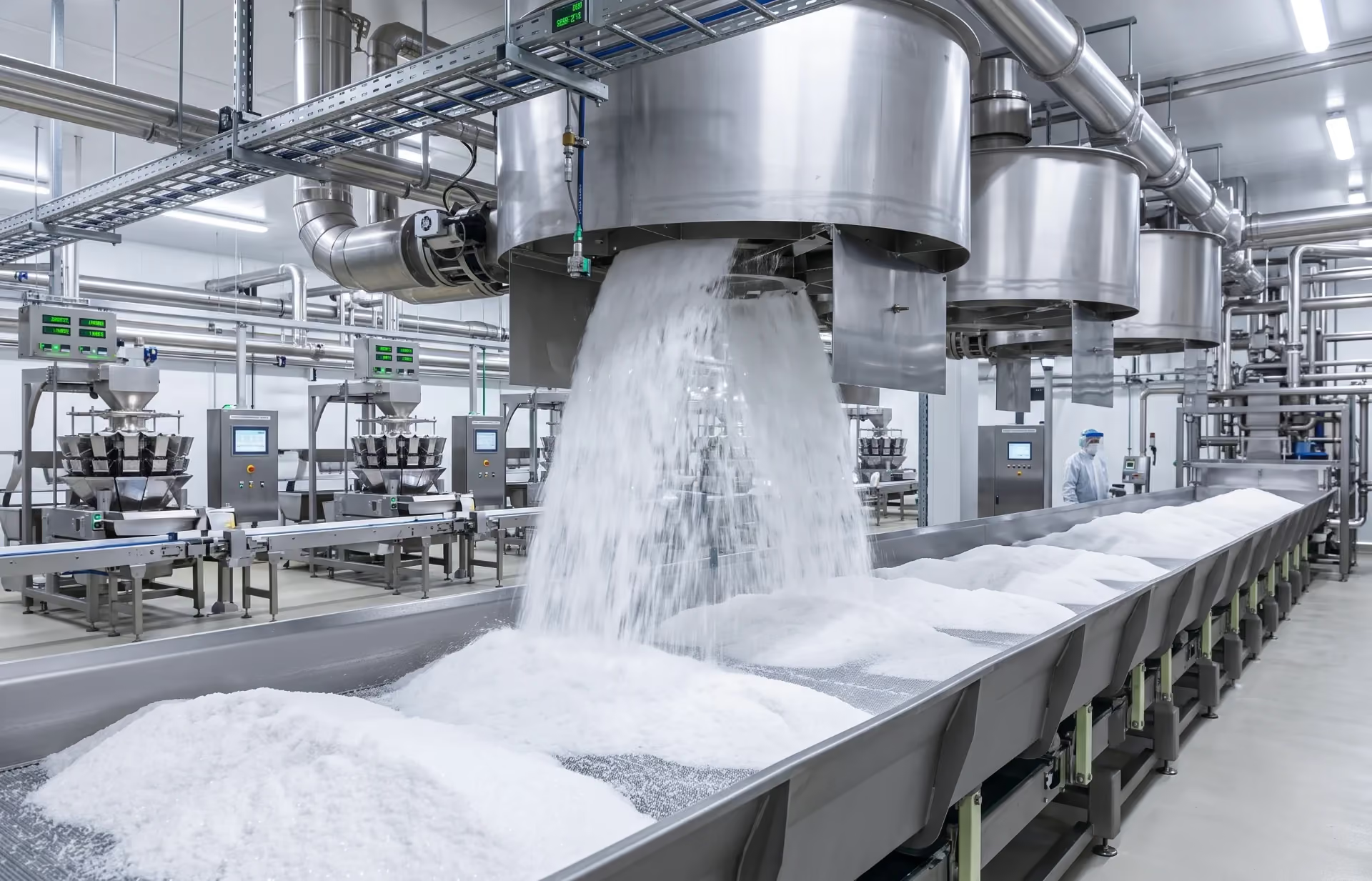
What is sugar dust?
Sugar dust is the fine, powdered fraction of sugar released when granulated and icing sugar are processed. It is produced by milling, sieving, pneumatic conveying, tipping and filling - anywhere sugar moves or falls.
Sugar is combustible. In crystal form nothing happens: a crystal has too little surface area to burn quickly. But disperse that same sugar finely enough in air and the total surface area becomes so large that the whole cloud can burn at once. That is a dust explosion.
Particle size is therefore the determining factor. Icing sugar from the mill reacts far more violently than coarse granulated sugar: the finer the dust, the less of it you need and the faster the pressure rises. The risk sits precisely where the most fines are produced - at the milling and sieving equipment.
The figures used for design
These values are used when sizing protective measures. They are deliberately conservative, so you can work with them without having your own sugar tested:
- Dust explosion class: St 1
- KSt value: approximately 140 bar·m/s
- Maximum explosion overpressure: approximately 9 bar
- Lower explosive limit: approximately 30 g/m³
- Ignition temperature of a dust cloud: approximately 310 °C
- Ignition temperature of a dust layer: approximately 380 °C
- Minimum ignition energy: below 5 mJ for fine fractions
These are not constants. They shift with particle size: finer dust ignites at a lower concentration and with more force, while coarse crystals may not ignite at all.
Why the second explosion is the dangerous one
The explosion that wrecks a plant is rarely the first. Something small happens — a spark at a mill, an elevator or a conveyor. That small blast lifts everything that has settled over the preceding months on ducting, beams and machine housings. That cloud then ignites, and it is large enough to reach the whole building.
A layer of less than a millimetre is enough. Cleaning and extraction are therefore not a matter of tidiness but of safety: where nothing has settled, no second explosion can occur.
The sparks themselves usually come from the machinery. In the food and feed industry, mechanically generated sparks account for around 35 percent of all dust explosions. Alongside these are hot surfaces such as an overheated bearing, electrostatic charging when filling silos, and smouldering nests that travel along the conveying route into the next section of plant.
What the law asks of you
If you process sugar dust you must assess the explosion hazards and record them in an explosion protection document. The ATEX directives apply to equipment (2014/34/EU) and to how you run the operation (1999/92/EC). Both are implemented in national law in each member state, which is where the detailed procedural requirements sit — so check what applies in your country.
Zone classification follows from how often and how long an explosive mixture is present:
- Zone 20: inside powder mills and powder bunkers
- Zone 21: elevators and big-bag filling stations without extraction
- Zone 22: granulated sugar silos and slow-running screw conveyors
The zone determines which equipment category is permitted. And therefore which requirements apply to the extraction system itself.
Sectors where sugar dust plays a role
- Sugar refineries and producers
- Industrial bakeries and pastry production
- Confectionery and chocolate manufacturing
- Soft drink and syrup production
- Powder blending and premix production
- Packers of dry foods
How do you protect against a sugar dust explosion?
The approach follows a fixed order: first make sure it does not happen, then make sure the damage stays contained, with clear working practices around both.
Prevention starts with extraction at source. It keeps the concentration below the level at which the mixture can ignite, and at the same time prevents the deposits from which a second explosion grows. In the extraction ducting itself you keep the air above 18 metres per second, because below that the dust settles along the way and you build the problem into your own ductwork.
Beyond that, the installation is built so an explosion cannot propagate: a housing that can take the pressure, vents or bursting discs that release it in a controlled way, spark detection with suppression, and rotary valves or fast-acting shut-off valves that stop a flame front reaching the next section. The whole installation is earthed and conductive so that electrostatic discharge cannot become an ignition source.
One thing needs particular attention with sugar: it attracts moisture and then becomes sticky. That makes the filter harder to clean than you may be used to with other dusts. Our engineers determine at each process step which combination of pre-separation, filtration and explosion protection is required.
Kiekens: your specialist in sugar dust extraction
With more than 100 years of experience in industrial dust extraction we design and build ATEX-compliant installations for hazardous areas in the food industry. From mill and silo to filling line: we capture the dust where it is created, keep the concentration low and prevent the deposits that feed a second explosion. From first sketch to maintenance and training, from a single source.
Want to know how to protect your sugar processing against dust explosions? Contact one of our specialists for a no-obligation conversation.
The principle is that no layer should be allowed to form that could produce an explosive mixture when disturbed. In practice a guide value of around one millimetre is often applied. The frequency therefore follows from how quickly the layer builds up, not from a fixed schedule. Clean by vacuuming rather than with compressed air: blowing down creates exactly the dust cloud you are trying to avoid.
Sugar dust is hygroscopic: it attracts moisture and becomes sticky as a result. In the filter this means the dust adheres and cleaning with compressed air pulses works less well than with flour dust. Process humidity, filter material and the settings of the filter cleaning system therefore need particular attention with sugar dust.
Not automatically. Both dust types are explosive and fall within the same dust explosion class, but their characteristic values differ, and sugar dust places different demands on filter cleaning because of its stickiness. An existing installation therefore has to be recalculated for transport velocity, filtration and explosion protection before sugar dust is put through it.