Extraction of gases and vapors
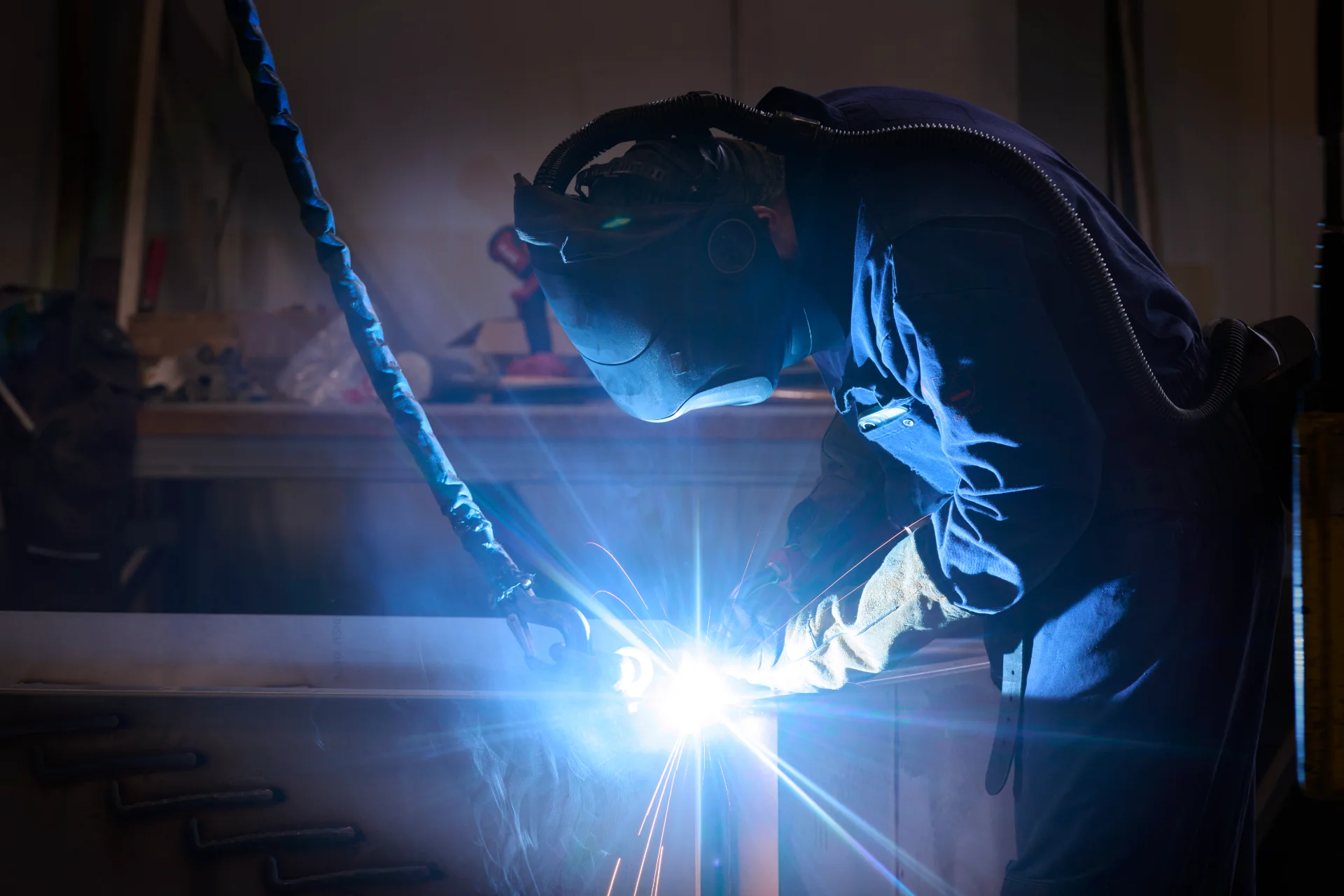
What are vapours?
Vapours form when a substance moves into the gas phase. That happens in two ways: through evaporation of a liquid at room temperature, or through heating, where a material decomposes and gives off gaseous products. In practice three kinds occur, and each calls for something different.
- Volatile organic compounds (VOCs). Solvents, thinners, adhesives, coatings and cleaning agents evaporate by themselves, even without heating. Think of a paint line, a gluing station or a degreasing bath.
- Thermal decomposition products. Heating, cutting, welding or burning breaks a material down and releases gases that were not present in the original material. PVC gives off hydrogen chloride, polyurethane gives off isocyanates, and almost any heated plastic produces carbon monoxide.
- Process and reaction gases. Gases formed as a by-product of the process itself: nitrogen oxides and ozone in welding, ammonia in certain chemical processes, reaction products from a curing oven.
Dust is often released at the same time. An arc produces both ultrafine particles and gases; an extruder produces chips and VOCs. That makes the installation a combination of two technologies, not a choice between them.
Why filtration works differently here
This is where the most common false assumption sits in practice.
A fabric filter, a cyclone and a HEPA filter all work mechanically: they retain particles too large to pass through. That principle does not apply to a gas molecule. It is many times smaller than the finest dust particle and passes through any filter medium as though it were not there.
Vapours are therefore captured through adsorption or absorption - you bind the molecule to another material rather than blocking it. That calls for activated carbon, a scrubber or an oxidation system.
That difference has two practical consequences.
- The order within the installation is fixed. Gas cleaning comes after dust filtration. The other way round, the activated carbon clogs with dust and loses its effect before it has absorbed a single molecule.
- You cannot see when it needs replacing. With a fabric filter the pressure drop rises and you know it is time. Activated carbon saturates without the pressure drop changing. By the time you can smell it, it is already past the point where it was working. Replacement therefore runs on throughput and measurement, not on judgement.
Health risks
What vapours do depends entirely on which substance is involved. Three mechanisms occur most often:
- Irritation and caustic effect. Acidic gases such as hydrogen chloride form acid as soon as they meet moisture - including in your airways and on your eyes. Ammonia and nitrous fumes act the same way.
- Sensitisation. Isocyanates from polyurethane are the best-known example here. The body can develop a permanent allergy, resulting in occupational asthma. Once sensitised, a person reacts to very low concentrations, which in practice means the end of working with that material.
- Systemic effects. Some solvents are absorbed through the lungs and act on the nervous system, liver or kidneys. Carbon monoxide displaces oxygen in the blood. This is the kind of exposure you notice little of on the shop floor until it is too late.
Which of these routes applies to you is set out in the safety data sheet for your material or coating. That is the starting point, not the product name.
What extraction achieves here
With vapours something else goes wrong that matters less with dust: a mask offers false reassurance. An ordinary dust mask does not stop gases at all, and a gas filter cartridge only works for the gas type it was selected for and only while it is not saturated. Capture at source is therefore not just more effective here, it is often the only measure that demonstrably works.
Legislation and standards
The EU Chemical Agents Directive requires employers to assess exposure and reduce it as far as possible, following a fixed order of control: eliminate or substitute first, then engineering controls at source, then organisational measures, with respiratory protection last. For sensitisers such as isocyanates, exposure must additionally be reduced as far as is reasonably practicable, even below the limit value.
Unlike dust, almost every gaseous component has its own exposure limit. There is no general vapour limit to fall back on. Your assessment therefore starts with establishing which substances are released, and that follows from your materials and your process. The assessment follows EN 689, and specific limit values are set nationally, so check what applies where you operate.
The emissions side also weighs more heavily here than with dust. If you discharge vapours outside, requirements under the Industrial Emissions Directive and your environmental permit come into play. For VOCs those requirements are strict, because they contribute to ozone formation in outdoor air. A solution that is adequate indoors can still be subject to permitting on the clean-air side.
Sectors where vapours play a role
- Metalworking and welding shops
- Plastics processing: extrusion, injection moulding and thermal cutting
- Paint, coating and printing operations
- Chemicals and pharmaceuticals
- Rubber and composite processing
- Waste and recycling operations
- Laboratories and technical workshops
How do you extract vapours effectively?
The principle is the same as with dust - capture where it is created - but the technology behind it is different.
- Source capture remains the basis. Vapours spread faster than dust, because they do not settle but mix with the surrounding air. What you miss at source, general ventilation will not recover.
- Dust first, gas afterwards. If dust is released as well, it comes out first. Otherwise your gas cleaning fills up with material that does not belong there.
For the gas cleaning itself there are three routes:
- Activated carbon binds the molecules to the vast internal surface of the carbon. Suitable for most VOCs and organic vapours, and the most widely applied solution. The carbon saturates and has to be replaced or regenerated periodically.
- Wet scrubbing dissolves the gas in a liquid, optionally with a reagent. The method of choice for acidic gases such as hydrogen chloride and for ammonia, where activated carbon achieves little.
- Thermal or catalytic oxidation burns the vapours into carbon dioxide and water. Worth considering at high, constant VOC concentrations, where replacing activated carbon otherwise becomes a running cost.
Which route fits depends on the substance, the concentration and whether the load is constant or peak-driven. Our engineers map that out per situation.
If your case specifically concerns welding fume or the heating of plastics, see our pages on welding fume and polymer dust - the technology for those processes is set out there.
Kiekens: your specialist in industrial gas and fume extraction
With over 100 years of experience in industrial extraction technology, we design and build systems that tackle both dust and fumes in a single solution. From a localized extraction workstation with an activated carbon post-filter to a centralized system with gas scrubbing.
We start by taking a look: what materials are you processing, what happens during heating, how consistent is the load, and what is being emitted. After that, we handle the design, installation, and maintenance—all under one roof. With our Clean Air Plan, we keep your system in top condition all year round, including the timely replacement of filter media that you cannot see saturating yourself.
Would you like to know which fumes are being released in your production process? Request a no-obligation baseline measurement from one of our specialists.
Your system likely captures dust, but not vapors. A fabric filter traps particles, not gas molecules—those pass right through. To handle vapors, you need activated carbon or a gas scrubber installed after the dust filtration. If you already have one, the carbon is likely saturated.
No. A dust mask filters particles but offers no protection against gases. For that, you need a gas filter cartridge suited to the specific type of gas, and these also become saturated over time. When it comes to vapors, source extraction is not only more effective but is often the only measure that is demonstrably effective.
Multi-step filter systems are recommended for the safe separation of fine plastic dust and volatile organic compounds (VOCs). For example, hose filters or filter cyclones ensure coarse and fine dust separation, while activated carbon filters or cartridges specifically neutralize vapors and odours.
CO₂, CH, NH₂, H₂S, and NOare common emissions. Good ventilation is essential for safety.