Coffee dust extraction
What is coffee dust?
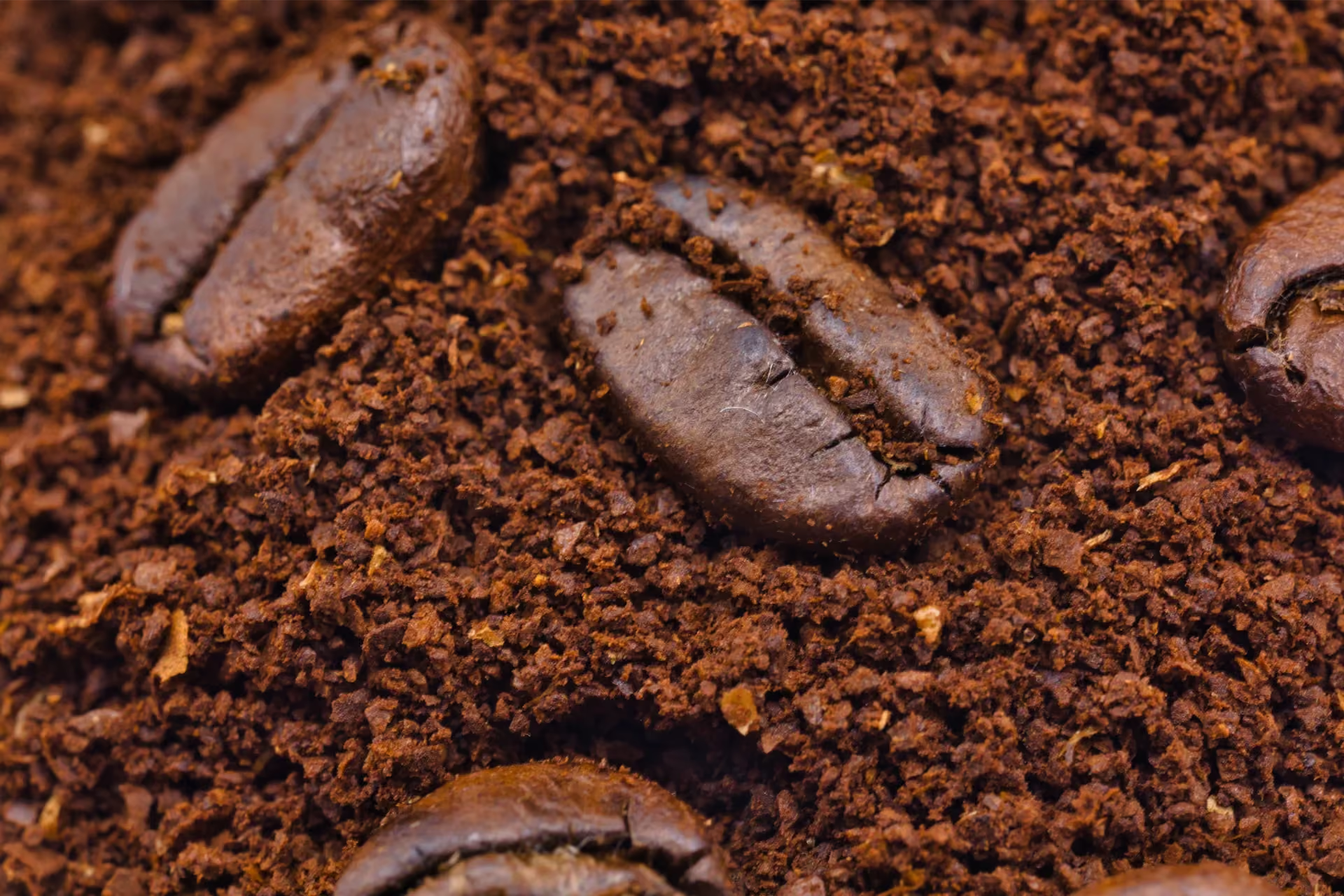
Coffee dust is a collective term for everything that becomes airborne during coffee processing. Broadly there are two kinds. The silverskin that comes off the bean during roasting, known in the trade as chaff: light, papery flakes carried along with the hot exhaust air. And the fine powder produced by grinding, conveying and filling.
Both are organic, dry and combustible. Dust is considered explosive once its particles are smaller than 0.5 millimetres, and ground coffee is well below that. Organic dusts such as coffee generally fall into dust explosion class St 1, with a KSt value up to 200 bar·m/s.
That makes coffee dust similar to other food industry dusts such as flour dust and sugar dust. What sets coffee apart is the combination: a hot process, a very light residue and a fine powder, all three in the same room.
Where does coffee dust come from?
Each process step produces a different kind of dust, which is why each has to be captured separately:
- Roasting: the silverskin separates from the bean and leaves as chaff with the exhaust air.
- Cooling and destoning: fine roast dust is stirred up in the cooling sieve.
- Grinding: this produces the finest dust, with particles well below half a millimetre.
- Conveying and sack emptying: green and roasted coffee generate dust during pneumatic transfer and tipping.
- Filling and packing: coffee powder escapes at open transfer points.
Because chaff is so light and dry, it accumulates in large quantities in the cyclone. And that is exactly where loose skin turns into a continuous combustible layer.
Why coffee dust can explode
A dust explosion needs five things at once: combustible dust, dispersion into the air, oxygen, confinement and an ignition source. Remove any one of them and nothing happens. Extraction targets the dispersion: no dust cloud, no explosion.
That is simpler in theory than in practice, because a roastery has oxygen and heat by design. What you can control is how much dust is airborne and how much is left lying around.
Chaff is the biggest fire source
Chaff is the most common cause of fire in the roasting process. It is extremely light, burns very fast, and can develop into a smouldering nest in the cyclone or exhaust duct. A documented roastery fire shows the chain clearly: the exhaust fan fails, the burner keeps running without cooling, and the roast catches fire.
The practical conclusion is that the cyclone and chaff collector need cleaning on a fixed schedule, and that all metal parts must be earthed to dissipate static charge. That last point is often overlooked on plastic duct sections added later.
Health risks and exposure limits
Explosion risk is not the only reason extraction is needed. The same fine dust also affects your employees' airways.
Green coffee is the main concern. Raw coffee dust is a sensitiser: the body can develop an allergy to it, resulting in asthma and allergic rhinitis. Coffee is a recognised occupational allergen and occupational asthma from coffee dust is a registered occupational disease across Europe. Roasting largely destroys the allergen, but the roast dust that follows remains mechanically irritating to the nose and bronchi.
Occupational exposure limits for organic dust are set nationally, so the applicable figure depends on where you operate. The framework is consistent: the EU Chemical Agents Directive requires you to assess exposure, establish a limit and demonstrably keep below it, following EN 689. For a sensitiser such as green coffee, exposure must additionally be reduced as far as is reasonably practicable - even when you are below your own limit.
Sectors where coffee dust plays a role
- Coffee roasteries, from artisanal to industrial scale
- Coffee grinding and packing operations
- Producers of instant coffee and coffee extracts
- Capsule and pod manufacturers
- Green coffee handling and storage
- Producers of coffee blends and premixes
How do you extract coffee dust effectively?
The principle is straightforward: capture the dust where it is created, separate the coarse fraction first and filter the fine fraction afterwards. In a roastery that means four components working together.
- Source capture: collects the dust directly at the roaster, the mill and the filling point.
- Cyclone and pre-separator: remove chaff and coarse particles mechanically so the main filter does not clog.
- Fabric filter: retains the fine dust and keeps you below your exposure limit.
- ATEX construction: pressure relief, spark detection and earthing make the installation suitable for combustible dust.
For precise capture at dosing and grinding points, high vacuum works best: a lot of force over a small area. For fine dust released across a larger area, low vacuum is the better fit.
The installation has to meet ATEX directives 2014/34/EU and 1999/92/EC and be covered by your explosion protection document. How fine the filtration needs to be and how robust the explosion protection depends on your throughput and grind size. That is why every installation is calculated individually.
Kiekens: your specialist in coffee dust extraction
With more than 100 years of experience in industrial dust extraction we design, build and maintain extraction systems for food and coffee processing. From 3D design through certified ATEX installation to service, from a single source. We start by looking: where the roaster sits, how the exhaust runs, what happens to the chaff. The Clean Air Plan keeps the installation performing year-round.
Want to know how much dust your roasting and grinding equipment produces? Request a free baseline measurement from one of our specialists.
Chaff does not have to go out as general waste. It is a dry, organic product and is commonly passed on as biomass, compost feedstock or animal bedding. What does matter: as long as it sits in the collector, it is combustible material. Do not store it in the roastery itself and do not let the container fill up — a full chaff bin next to a hot installation is exactly the combination you want to avoid.
There is no fixed interval that works for every roastery. The frequency follows from how quickly the layer builds up, which depends on your bean variety, roast profile and throughput. A practical rule: inspect the cyclone and exhaust duct after two weeks and set your interval based on what you find. If there is a continuous layer, clean more often. Put the schedule in your maintenance plan so it does not depend on who happens to be paying attention that week.
Yes. With green coffee the emphasis is on health: raw coffee dust is a sensitiser and can trigger an allergy. Capture at sack emptying, tipping and conveying is the priority there. With roasted coffee the allergen is largely destroyed, but chaff and fine grinding dust are added — shifting the emphasis to fire and explosion control. Most roasteries have both, so the installation has to handle both.