Industrial process air purification


What is process air purification?
Process air purification is the targeted capture, filtering and cleaning of contaminated air produced during industrial manufacturing processes. Dust, vapours, aerosols and gases are extracted directly at the source and cleaned by powerful filter systems. The goal is to keep air quality in the work area consistently high and to either return the cleaned air to the room or discharge it outside. Modern process air purification systems use multi-stage filters that reliably separate even the finest particles. Process air is the air directly involved in the production process. Once it is discharged after use, it is called process exhaust air, and cleaning it before release to the outside is subject to its own environmental requirements.
Air cleaner, wet scrubber or filter system: what is the difference?
Several terms are used for the same task, but technically they describe different methods. An industrial air cleaner, a filter system and a wet scrubber each separate particles from the process air in a different physical way, and that difference determines which system suits your dust:
| System | Working principle | Typical use |
|---|---|---|
| Industrial air cleaner | Dry filtration with cartridge or bag filters, usually mobile or room-based | Individual workstations, changing locations, grinding dust and fine dust |
| Filter system | Multi-stage, stationary filters in a networked ductwork system | Central extraction for entire production halls |
| Wet scrubber (wet separator) | Particles are bound in water instead of being filtered dry | Oily, moist or spark-producing dust, for example in metalworking |
| Exhaust air cleaning | Cleaning the process exhaust air before it is released outside | Meeting emission limits in your environmental permit |
Which method ends up doing the job depends less on the name than on the type of dust, the volume and the explosion risk. With combustible organic or metal dust, explosion protection also determines the choice.
Why is process air purification important?
Effective process air purification is indispensable in almost every branch of industry. Metalworking, woodworking, plastics production and chemical production all generate emissions that endanger employee health without proper extraction. Prolonged exposure to harmful substances can lead to respiratory diseases, allergies or chronic complaints. Air purification also protects sensitive machines against dust deposits and wear, extending their lifespan and reducing maintenance costs. Finally, a clean working environment is a prerequisite for complying with occupational health and safety rules and environmental requirements.
Benefits of process air purification
- Health protection: Reduces exposure to dust, fumes and pollutants.
- Compliance: Helps meet legal air quality requirements.
- Product quality: Minimises contamination and increases precision in production.
- Machine protection: Prevents dust deposits on equipment and extends its lifespan.
- Energy efficiency: Modern systems adapt their consumption to demand.
- Environmental protection: Reduces pollutant emissions.
- Productivity: Clean air supports employee concentration and well-being.
Applications of process air purification
Process air purification is used in many industries. In metalworking, welding fumes, grinding dust and metal particles are extracted. The wood industry benefits from removing fine wood dust and chips. In plastics processing, the systems filter vapours and particles created during injection moulding or extrusion. Reliable process air purification is also essential in food production, pharmaceuticals and recycling, to guarantee hygienic conditions and protect employees.
How do air cleaners work against welding fumes and grinding dust?
Welding fume consists of respirable metal oxide particles that penetrate deep into the lungs. Under EU occupational health rules, and COSHH in the UK, employers must control exposure at the source first, which for welding means local exhaust ventilation. An air cleaner for welding and grinding stations extracts the fume through an extraction arm or hood right at the seam and passes it through multi-stage filters, the last of which retains particles down to the fine dust range. Because welding fume is classified as carcinogenic, capture at the source counts for more than any general ventilation. Read how such a system is built in our article on welding fume extraction.
How effective are air cleaners against oil mist?
Oil mist and emulsion aerosols form on machine tools when coolants atomise at high speeds. Unlike dry dust, oil mist settles as a sticky film on filters, floors and machines, which is why separators with multi-stage droplet separation are used instead of dry filters alone. A properly sized oil mist separator keeps the aerosol concentration below the exposure limit and keeps the floor slip-free. Which technology suits which machine is explained in our guide to oil and emulsion mist separators.
Air purification in food production
In food and feed production, process air purification has to meet two goals at once: hygienically clean air and explosion protection for organic dust such as flour, sugar or starch. Systems with hygienic design can be cleaned without residue and prevent product remnants from settling in the ductwork. At the same time, spark-free, ATEX-compliant components reduce the risk of a dust explosion. Because a standard system rarely meets both requirements, we have tailored solutions for this sector.
Types of process air purification systems
Depending on requirements and company size, various systems are available:
Central dust extraction systems
Central dust extraction systems are ideal for large production facilities with multiple workstations. They capture emissions at various points and carry the contaminated air through a ductwork network to a central filter unit. This makes them particularly cost-efficient and powerful.
Mobile dust extraction systems
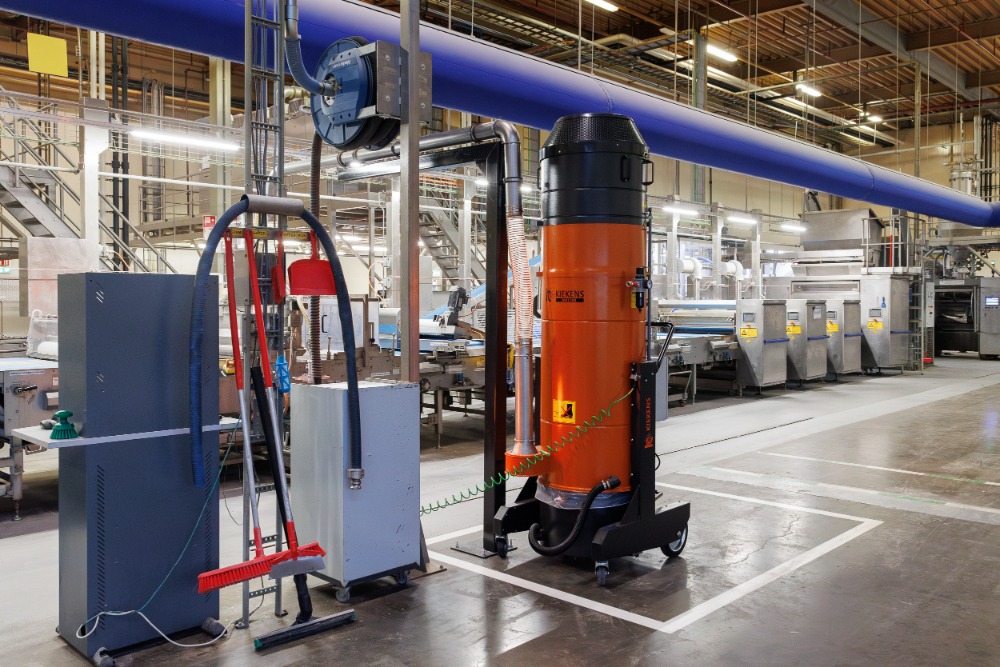
Mobile dust extraction systems excel in flexibility. They can be placed exactly where harmful substances are created and are particularly suitable for changing or temporary workstations. Kiekens' mobile systems are equipped with robust extraction arms and adapt quickly to different conditions.
Stationary filter systems
Stationary filter systems are permanently installed at a work area and designed for continuous operation. They can be combined with extraction tables, extraction arms or hoods and ensure continuous capture and filtration of pollutants.
ATEX-compliant process air purification
In explosive atmospheres, ATEX-certified process air purification is essential. The ATEX directives (ATmosphères EXplosibles) apply to all installations operated in environments with combustible dust, gases or vapours. ATEX-compliant systems are equipped with spark-free components, earthing systems and special filters to minimise the risk of explosion. At Kiekens we offer solutions that meet all relevant safety standards. The key rules are the equipment directive 2014/34/EU and the workplace directive 1999/92/EC (in the UK: UKEX and DSEAR), which assign graded protective measures to dust zones 20, 21 and 22. When dust actually becomes explosive is explained in our article on combustible dust and dust explosions.
Filter technologies in process air purification
Modern process air purification systems use various filter technologies:
- HEPA filters: Filter up to 99.97% of all particles and are suitable for the finest dust.
- Activated carbon filters: Absorb gases, vapours and odours, so they also act as odour filters.
- Cyclone separators: Separate coarse particles by centrifugal force.
- Wet separators (wet scrubbers): Bind particles with water and suit oily or spark-producing dust.
- Electrostatic filters: Charge particles electrically and capture them on collector plates.
Recirculation or exhaust: where does the cleaned air go?
After filtration you have to decide whether to return the cleaned air to the hall or discharge it outside. Both options have clear consequences for energy costs and permits:
- Recirculation: The cleaned air stays in the hall. This saves considerable energy costs in the heating season, but requires monitored clean air quality so that no residual particles return.
- Exhaust to outside: The process exhaust air is discharged after cleaning. This is necessary for critical gases or odours and must meet the emission limits in your environmental permit.
Because recirculated heat stays in the building, recirculation pays off especially where large air volumes are moved. Whether it is permitted depends on the substance and on the design of the system.
How do you improve air quality in a factory?
To keep the air in an industrial hall clean for good, the most effective lever is not the strongest general ventilation, but capture at the source before the dust spreads. For cleaning entire halls, we add production hall extraction to this approach. Four steps lead from diagnosis to permanently clean production air:
- Map the sources: Record every process that releases dust, fumes or aerosols and assess it by volume and hazard.
- Choose capture points: Place the extraction arm, hood or table as close as possible to the emission.
- Size the air flow: Match capture velocity and duct diameter to the type of dust, so extraction works at every point. The relationship between volume flow and negative pressure explains why an undersized system leaves dust behind.
- Measure the effect: A free baseline measurement shows the starting situation and makes the system's result verifiable.
This way the dust load in production drops measurably, instead of just being diluted. To make sure the system fits your operation exactly, Kiekens handles design, construction and maintenance under one roof.
Kiekens process air purification – your tailor-made solution
At Kiekens, we have more than 100 years of experience in developing and supplying dust extraction systems and air purification systems. We know every company is different. That is why we do not offer standard off-the-shelf solutions, but process air purification tailored to your needs. Our systems are modular and can be flexibly adapted, whether you are looking for an energy-efficient solution for sustainable operation or an ATEX-certified installation for hazardous areas. Our experts are happy to advise you personally and guide you from design to maintenance. Get in touch and we will find the right extraction solution for your company together.
Process air purification means the targeted capture and filtering of harmful substances such as dust, vapors and gases that are created during industrial production processes. The goal is to keep the air quality in the workplace high and to protect employees and machines.
Process air purification is important in almost all manufacturing sectors, including metalworking, wood industry, plastic production, food production, pharmaceutical industry and recycling. Wherever production produces emissions, effective air cleaning is required.
The costs for a process air purificaiton installation depend on various factors: company size, type of emissions, required filter performance and specific requirements such as ATEX certification. At Kiekens, we advise you individually and find the solution that optimally suits your budget and requirements.