Dust classes: classification, limit values and requirements for extraction systems

Below, we explain how the three dust classes are defined, what limit values and filtration efficiency levels apply, and how the correct dust class influences the selection of your extraction technology.
What are dust classes?
Dust classes are a standardised classification of dust types according to their health risk in the workplace. They define how hazardous a dust is to people and what requirements the filter system of a vacuum or extraction unit must meet.
The standard IEC 60335-2-69 (in Europe also published as EN 60335-2-69) divides dust into three classes of increasing hazard: dust class L for low-hazard, dust class M for medium-hazard and dust class H for high-hazard dust.
Importantly: industrial vacuums and dust extractors are classified into the same dust classes as the dust types themselves. A class M machine may only be used for dust of classes L and M. For high-hazard class H dust, an H-certified machine is mandatory.
The classification of vacuums ensures that extracted dust particles do not re-enter the breathing air of workers via the exhaust.
The three dust classes at a glance
Dust class L - low-hazard dust
Dust class L covers dust types with a low health risk. These include household dust, sand, gypsum, lime and comparable materials that arise during building cleaning, for example.
In terms of filter technology, a class L vacuum is comparable to a standard household vacuum cleaner. The workplace exposure limit is above 1 mg/m3 and the required filtration efficiency of the filter is at least 99%.
In many countries, class L vacuums are not permitted for dust-generating work on construction sites. Always verify the applicable national regulations for your country.
Dust class M - medium-hazard dust
Dust class M covers dust types that present a medium health risk. Typical examples include wood dust, metal dust, paint particles, concrete dust and cement dust. These dust types are generated during sanding, drilling, milling or sawing and often contain particles at the nanoscale that can penetrate deep into the lungs.
Class M vacuums are equipped with warning signals when suction power decreases and allow for low-dust disposal.
The permitted limit value is 0.1 mg/m3 and the filtration efficiency must be at least 99.9%. On construction sites and in most trade and industrial businesses, dust class M is the absolute minimum requirement.
Dust class H - high-hazard dust
Dust class H applies to severely health-hazardous and carcinogenic dust types such as asbestos, mould spores, lead dust and mineral fibres. Flour dust in high concentrations and certain pharmaceutical dusts also fall into this category.
Class H vacuums must meet a range of constructive requirements to be suitable for removing high-hazard dust. The filtration efficiency is at least 99.995%, disposal must be dust-free, and the entire machine is subject to the strictest leakage tests. The limit value is below 0.1 mg/m3.
Filtration efficiency and limit values: what matters
The differences between dust classes L, M and H lie in the hazard level of the dust and the resulting requirements for filter performance. With dust class L, up to 1% of dust particles may pass through the filter system. With dust class M, this drops to 0.1%, and with dust class H to just 0.005%.
This means the requirements for filter material in class H are 200 times higher than for a standard household vacuum cleaner.
For your working environment, this has direct consequences. A vacuum or extraction system with too low a dust class will not filter out the fine, health-hazardous dust sufficiently and will return it to the room air via the exhaust. This not only endangers the health of workers but also constitutes a violation of applicable workplace exposure limits, which vary by country and region.
Which dust class applies to your industry?
The choice of the correct dust class is a legal requirement and is based on the risk assessment of the relevant workplace. In practice, many businesses work with dust types from multiple classes.
A roofing contractor may encounter household dust (dust class L), wood dust (dust class M) and asbestos dust (dust class H) all in a single working day. In woodworking, metalworking and on construction sites, dust class M is the minimum requirement.
In the chemical and pharmaceutical industries, during asbestos remediation and wherever carcinogenic substances are processed, dust class H is mandatory.
Long-term dust exposure can have serious consequences, ranging from chronic respiratory diseases and allergies to lung cancer. Employers are therefore obliged to limit dust exposure in the workplace to the legally permitted values applicable in their country or region. Where individual vacuums cannot maintain these limits, central extraction systems must be installed to continuously remove dust from the air.
From dust class to the right extraction system
For individual workstations in a workshop or trade environment, a mobile industrial vacuum of the appropriate dust class is often sufficient.
In industrial production environments with continuous dust exposure at multiple sources, the mobile vacuum reaches its limits. This is where central extraction systems come in, capturing dust directly at the source and conveying it through pipe networks to a central filter unit.
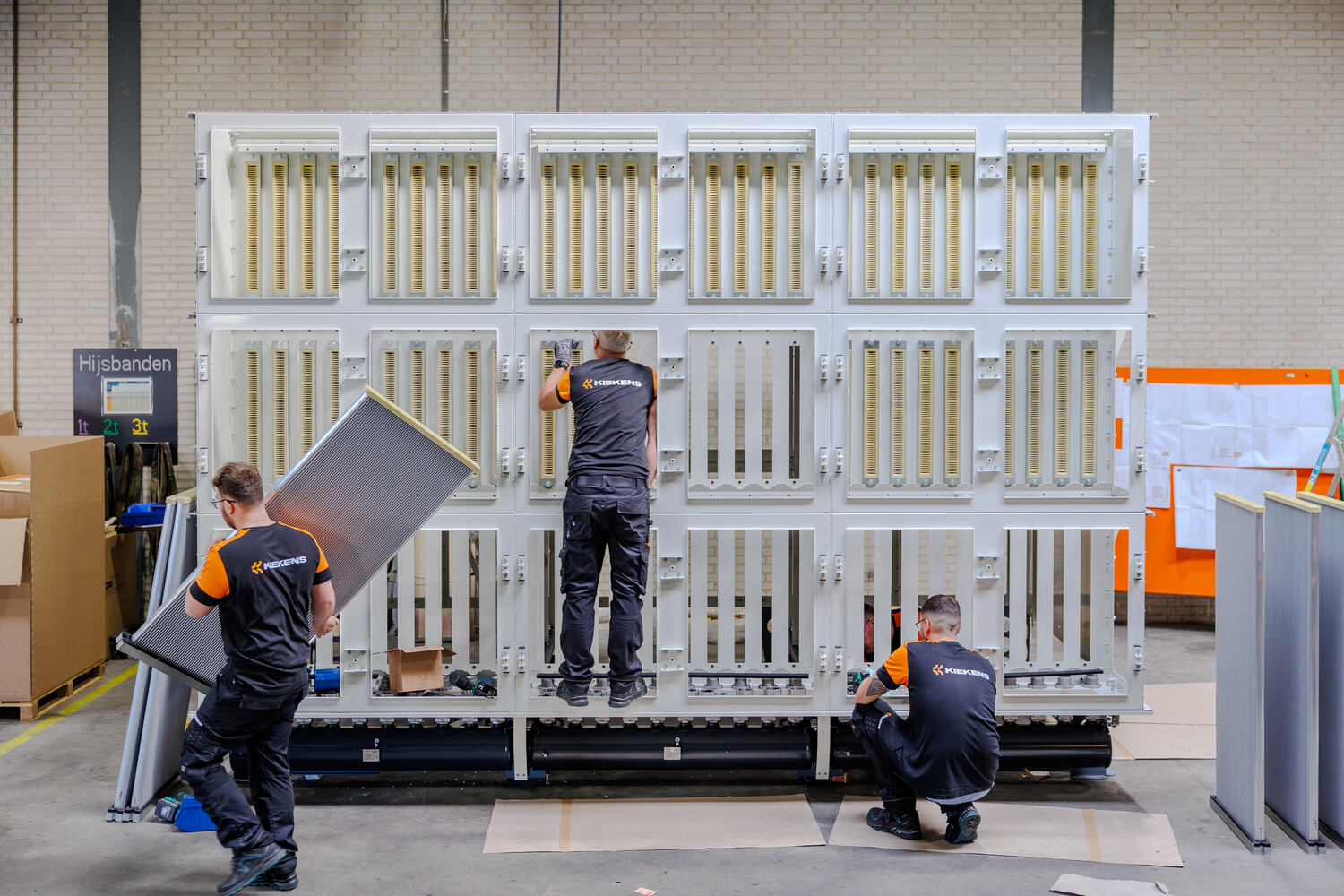
At Kiekens, we see every day how decisive the dust class is when engineering such a system. The dust class determines not only the filter medium but also the design of the pipework, the power of the fans, the method of dust disposal and the required safety components.
For medium-hazard class M dust, we use filter systems with a filtration efficiency of at least 99.9%, combined with automatic filter cleaning and low-dust disposal. For high-hazard class H dust, pressure-resistant filter units such as the Dustmaster 9.000 are used, guaranteeing the highest filtration efficiency levels and ensuring dust-free disposal.
Equally important: many industrial dust types in classes M and H are simultaneously combustible or explosive. In these cases, the entire extraction system must also comply with the ATEX directives. From antistatic hoses and spark-protected motors to fans in accordance with EN 14986, dust class and explosion protection are directly interlinked.
Safe working air with Kiekens
At Kiekens, we have been developing industrial extraction solutions for over 115 years, tailored precisely to your production process and the dust classes involved. No standard solution, but a custom-built system that protects your employees and reliably meets the applicable legal limit values. All components are manufactured in the Netherlands and all specialists work in-house.
Contact us for a tailor-made extraction solution that meets your requirements in terms of dust class, filter performance and occupational safety.
There are three dust classes according to IEC 60335-2-69: dust class L for low-hazard dust, dust class M for medium-hazard dust and dust class H for high-hazard and carcinogenic dust.
On construction sites, dust class M is generally the minimum requirement. Class L vacuums are typically not permitted for dust-generating work on construction sites. For asbestos remediation or contact with carcinogenic substances, dust class H is required. Always check the specific regulations applicable in your country.
The difference lies in the hazard level of the dust and the required filter performance. Dust class M requires a filtration efficiency of 99.9% at a limit value of 0.1 mg/m3. Dust class H requires 99.995% filtration efficiency and is mandatory for carcinogenic dust such as asbestos and mould spores.
An extraction system designed for the highest dust class present automatically covers the lower classes as well. Kiekens designs systems tailored to the specific dust classes in your facility, while ensuring occupational safety at every workstation.
