Dust extraction for herbicide powder
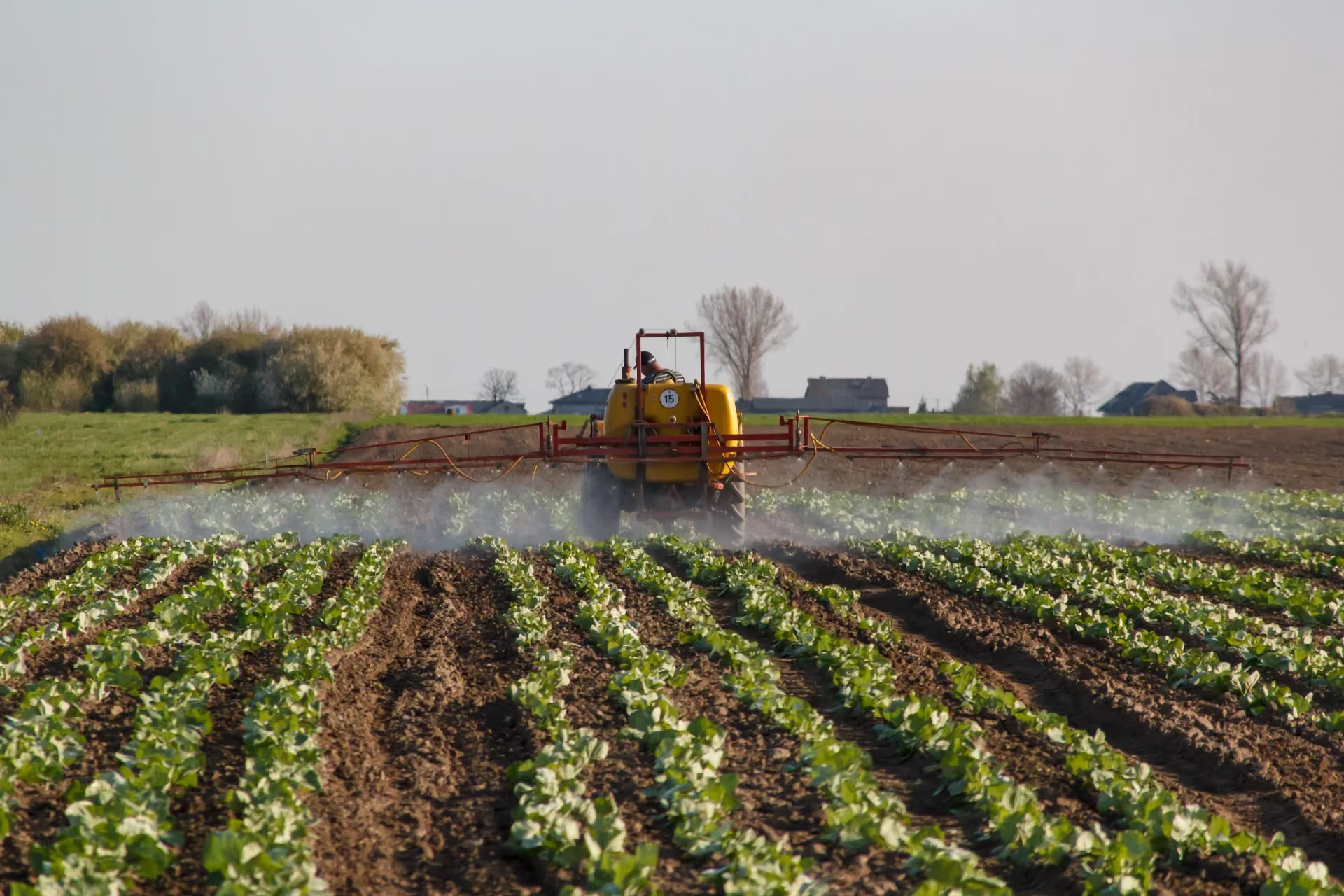
What is herbicide dust?
Herbicides are crop protection products specifically developed to suppress plant growth. Weighing, mixing, milling, sieving and packaging powder and granular formulations releases fine dust that contains the active substance. This makes herbicide dust fundamentally different from organic dust such as grain or flour dust: it isn't harmful by accident, but deliberately biologically active - designed to take effect even at low concentrations. That same property makes it risky for people and the environment.
Health and environmental risks of herbicide dust
Toxicological exposure at low concentrations
Many active substances in herbicides are classified as CMR substances under the CLP Regulation: carcinogenic, mutagenic or toxic to reproduction. Exposure limits are therefore often set in micrograms per cubic metre, rather than milligrams as with organic dust. Even a small leak or an inadequately sealed transfer point can push exposure above the limit.
Skin and eye contact
Herbicide dust isn't just an inhalation risk. Many formulations cause irritation or sensitisation on skin and eye contact. Personal protective equipment alone is not enough - exposure needs to be prevented at the source.
Environmental risk from release
Herbicides are designed to be effective against plant growth even at low doses. Accidental release into the air or wastewater therefore affects not only employees but also the surrounding environment: soil, surface water and neighbouring crops. That makes containment just as important as extraction.
Regulations around herbicide dust
The production and processing of herbicides falls under a combination of regulations: the CLP Regulation for the classification and labelling of hazardous substances, EU occupational policy on CMR substances (including substitution requirements and exposure documentation), and the EU Plant Protection Products Regulation governing authorisation and use. For storage, local hazardous substance storage requirements also apply. If the formulation contains a combustible organic powder, the ATEX Directives apply as well - in that case, explosion risk is an additional, not the only, consideration.
Sectors where herbicide dust plays a role
- Manufacturers and formulators of crop protection products
- Packers and repackers of herbicides
- Blending stations for agriculture and horticulture
- Quality and research laboratories in agrochemistry
Effective dust extraction for herbicide dust
Effective dust extraction for herbicide dust is about containment, not just capture. Closed transfer points, high-efficiency filtration (HEPA/ULPA) and a safe, dust-free way of changing filters prevent employees or the environment from coming into contact with the active substance. When formulations change, a thorough cleaning routine is also needed to prevent cross-contamination between products. Our engineers determine the right combination of containment, filtration and - where relevant - ATEX measures for each situation.
Kiekens: your specialist in herbicide dust extraction
With more than 100 years of experience in industrial dust extraction, Kiekens also delivers tailored solutions for the chemical and agrochemical industry: from closed extraction systems with HEPA filtration to fully integrated installations that meet the strictest requirements for hazardous substances. With the Clean Air Plan, we keep the installation in top condition all year round.
Want to know how to structurally address herbicide dust exposure in your business? Contact one of our specialists for a no-obligation consultation.
CMR substances (carcinogenic, mutagenic or toxic to reproduction) are harmful because of their biological action, even at low concentrations and without any explosion risk. Explosive dust, such as grain or metal dust, poses a risk because of the physical properties of the dust combined with air and an ignition source. Many active substances in herbicides are classified as CMR substances; explosion risk depends on the specific formulation.
Cross-contamination is prevented through closed transfer points, separated or thoroughly cleanable pipework, and a fixed cleaning routine at every product changeover. Filters and filter housings are designed so they can be changed or cleaned easily and without raising dust, so residues from the previous formulation don't end up in the next product.
This legislation mainly governs the authorisation and use of crop protection products, not the extraction system itself. It does, however, work alongside occupational safety regulations and the CLP Regulation, which set requirements for employee exposure and therefore indirectly for the required extraction and filtration capacity.
Exposure is usually measured through workplace air monitoring, compared against the legal exposure limit for the specific active substance. For CMR-classified substances, this forms part of the mandatory exposure documentation. A well-designed extraction and filtration system keeps the concentration structurally below the limit, so measurements more often provide reassurance than a reason to intervene.
For health-hazardous fine dust, a high-vacuum system with HEPA filtration is often chosen, such as the Dustmaster 9.000, or the Vacmaster with HEPA module for smaller central systems. Both are also available in an ATEX version, for situations where explosion risk exists alongside the toxicological risk.